|
1020 Regent St
(Lower Level)
Madison, WI 53715
(608) 819-6505
|
| |
|
Click above to send names of those to be commemorated at Liturgy. |
| |
Sunday, December 7, 2025
Tone 1; 26th Sunday after Pentecost (11th of Luke); St. Ambrose, Bishop of Milan |
| |
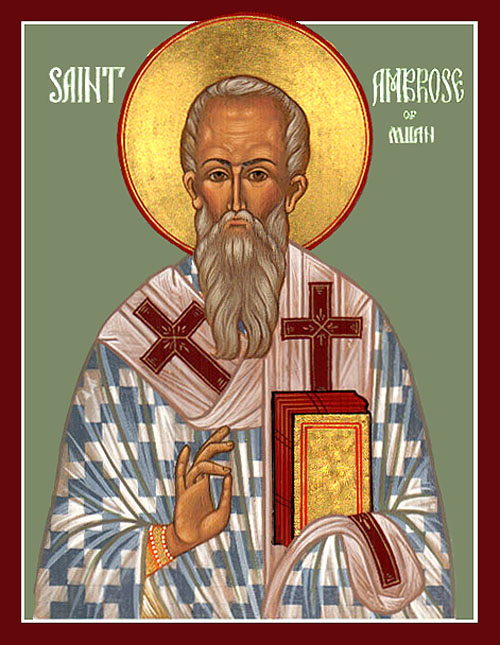
Saint Ambrose, Bishop of Milan
Commemorated on December 7
(OCA) Saint Ambrose, Bishop of Milan, was born in the year 340 into the family of the Roman prefect of Gaul (now France). Even in the saint’s childhood there appeared presentiments of his great future. Once, bees covered the face of the sleeping infant. They flew in and out of his mouth, leaving honey on his tongue. Soon they flew away so high that they could no longer be seen. Ambrose’s father said that the child would become something great when he reached manhood.
After the death of the father of the family, Ambrose journeyed to Rome, where the future saint and his brother Satyrius received an excellent education. About the year 370, upon completion of his course of study, Ambrose was appointed to the position of governor (consular prefect) of the districts of Liguria and Aemilia, though he continued to live at Mediolanum (now Milan).
In the year 374 Auxentius, the Arian Bishop of Mediolanum, died. This led to complications between the Orthodox and the Arians, since each side wanted to have its own bishop. Ambrose, as the chief city official, went to the church to resolve the dispute.
While he was speaking to the crowd, suddenly a child cried out, “Ambrose for bishop!” The people took up this chant. Ambrose, who at this time was still a catechumen, considered himself unworthy, and tried to refuse. He disparaged himself, and even tried to flee from Mediolanum. The matter went ultimately before the emperor Valentinian the Elder (364-375), whose orders Ambrose dared not disobey. He accepted holy Baptism from an Orthodox priest and, passing through all the ranks of the Church clergy in just seven days, on December 7, 374 he was consecrated Bishop of Mediolanum. He dispersed all his possessions, money and property for the adornment of churches, the upkeep of orphans and the poor, and he devoted himself to a strict ascetic life.
Ambrose combined strict temperance, intense vigilance and work within the fulfilling of his duties as archpastor. Saint Ambrose, defending the unity of the Church, energetically opposed the spread of heresy. Thus, in the year 379 he traveled off to establish an Orthodox bishop at Sirmium, and in 385-386 he refused to hand over the basilica of Mediolanum to the Arians.
The preaching of Saint Ambrose in defense of Orthodoxy was deeply influential. Another noted Father of the Western Church, Saint Augustine (June 15), bore witness to this, having accepted holy Baptism in the year 387 by the grace of the preaching of the bishop of Mediolanum.
Saint Ambrose also actively participated in civil matters. Thus, the emperor Gracian (375-383), having received from him the “Exposition of the Orthodox Faith” (De Fide), removed, by decree of the saint, the altar of Victory from the halls of the Senate at Rome, on which oaths were wont to be taken. Displaying a pastoral boldness, Saint Ambrose placed a severe penance on the emperor Theodosius I (379-395) for the massacre of innocent inhabitants of Thessalonica. For him there was no difference between emperor and commoner. Though he released Theodosius from the penance, the saint would not permit the emperor to commune at the altar, but compelled him to do public penance.
The fame of Bishop Ambrose and his actions attracted to him many followers from other lands. From far away Persia learned men came to him to ask him questions and absorb his wisdom. Fritigelda (Frigitil), queen of the military Germanic tribe of the Markomanni, which often had attacked Mediolanum, asked the saint to instruct her in the Christian Faith. The saint in his letter to her persuasively stated the dogmas of the Church. And having become a believer, the queen converted her own husband to Christianity and persuaded him to conclude a treaty of peace with the Roman Empire.
The saint combined strictness with an uncommon kindliness. Granted a gift of wonderworking, he healed many from sickness. One time at Florence, while staying at the house of Decentus, he resurrected a dead boy.
The repose of Saint Ambrose, who departed to the Lord on the night of Holy Pascha, was accompanied by many miracles. He even appeared in a vision to the children being baptized that night. The saint was buried in the Ambrosian basilica in Mediolanum, beneath the altar, between the Martyrs Protasius and Gervasius (October 14).
A zealous preacher and valiant defender of the Christian Faith, Saint Ambrose received particular renown as a Church writer. In dogmatic compositions he set forth the Orthodox teaching about the Holy Trinity, the Sacraments, and Repentance: “Five Books on the Faith” (De Fide); “Explication of the Symbol of the Faith” (Explanatio Symboli); “On the Incarnation” (De Incarnationis); “Three Books on the Holy Spirit” (De Spiritu Sancto); “On the Sacraments” (De Sacramento); “Two Books on Repentance” (De Paenitentia). In writings about Christian morality, he explained the excellence of Christian moral teaching compared to pagan moral teaching.
A well-known work of Saint Ambrose, “On the Duties of the Clergy” (De Officiis Ministrorum) evidences his deep awareness of pastoral duty. He stresses that those who serve in the Church should have not only the proper knowledge of Church services, but also the proper knowledge of moral precepts.
Saint Ambrose was also a reformer of Church singing. He introduced antiphonal singing (along the Eastern or Syrian form) into the Western Church, which became known as “Ambrosian Chant.” He also composed twelve hymns which were used during his lifetime. The hymn, “Thee, O God, we praise” (Te Deum), attributed to Saint Ambrose, entered into the divine services of the Orthodox Church (Molieben). |
| |
|
Glory to Jesus Christ!
Between illness and snow storms, November has been an irregular month. God willing, life will settle down in December.
This week we will have Vesper & Liturgy for St. Nicholas. Vespers will be at 5:30 PM, Friday. December 5 with Liturgy Saturday, December 6, at 9:30 AM.
Looking ahead, we will have Vespers and Liturgy for the Conception of St. Anne, Monday, 18 and Tuesday 12/9.
In Christ,
Fr Gregory |
| |
This Week at Ss Cyril & Methodius
Wednesday, December 3
- 11:00 AM-3:00 PM: Office Hours/Confessions
Thursday, December 4
- 1:00 PM-5:00 PM: Office Hours/Confessions
Friday, December 5
- 3:00 PM-5:00 PM: Office Hours/Confessions
- 5:30 PM: Vespers (St. Nicholas)
Saturday, December 6 (St. Nicholas)
- 9:15 AM Hours
- 9:30 AM: Divine Liturgy
- 5:00 PM: Great Vespers
- 6:00 PM: Confessions
Sunday, December 7
- 9:15 AM: Hours
- 9:30 AM: Divine Liturgy
|
| |
Looking Ahead
Monday, December 8
Tuesday, December 9 (Conception of St. Anne)
Wednesday, December 10
- 11:00 AM-3:00 PM: Office Hours/Confessions
Thursday, December 11
- 1:00 PM-5:00 PM: Office Hours/Confessions
Friday, December 12
- 11:00 AM-3:00 PM: Office Hours/Confessions
Saturday, December 13
- 4:00 PM: Confessions
- 5:00 PM: Great Vespers
- 6:00 PM: Confessions
Sunday, December 14
- 9:15 AM: Hours
- 9:30 AM: Divine Liturgy
|
| |
|
Hymns After the Small Entrance
Tone 1 Troparion (Resurrection)
When the stone had been sealed by the Jews, while the soldiers were guarding Thy most pure body, Thou didst rise on the third day, O Savior, granting life to the world. The powers of heaven therefore cried to Thee, O Giver of Life: “Glory to Thy Resurrection, O Christ! Glory to Thy Kingdom!//Glory to Thy dispensation, O Thou Who lovest mankind!”
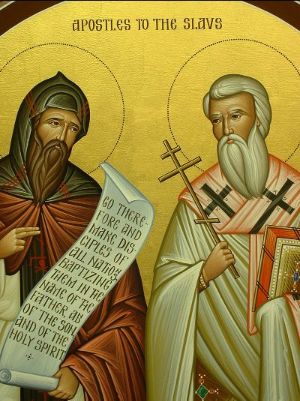
Tone 4 Troparion (Sts. Cyril & Methodius)
Divinely-wise Cyril and Methodius, / equals-to-the-apostles and teachers of the Slavs, / entreat the Master of all / to strengthen all nations in Orthodoxy and unity of mind, / to grant peace to the world and to save our souls.
Tone 4 Troparion (St. Ambrose)
In truth thou wast revealed to thy flock as a rule of faith, an image of humility and a teacher of abstinence; thy humility exalted thee; and thy poverty enriched thee. O Hierarch Father Ambrose, entreat Christ our God//that our souls may be saved!
Tone 1 Kontakion (Resurrection)
As God, Thou didst rise from the tomb in glory, raising the world with Thyself. Human nature praises Thee as God, for death has vanished. Adam exults, O Master! Eve rejoices, for she is freed from bondage and cries to Thee://“Thou art the Giver of Resurrection to all, O Christ!”
Tone 3 Kontakion (Sts. Cyril & Methodius)
Let us honor the sacred pair, who translated divine scripture / pouring forth a fountain of divine knowledge from which we still draw today. / Now as you stand before the throne of the Most-high / we call you blessed, Cyril and Methodius, / as you fervently pray for our souls.
Glory to the Father, and to the Son, and to the Holy Spirit,
Tone 3 Kontakion (St. Ambrose)
Thou didst shine forth with divine doctrine, eclipsing the deception of Arius, O shepherd and initiate of the mysteries, Ambrose. Thou didst work miracles through the power of the Spirit, healing various passions;// righteous Father, entreat Christ our God to grant us His great mercy.
now and ever, and unto ages of ages. Amen.
Tone 6 Kontakion
Steadfast protectress of Christians, / most constant advocate before the Creator, / do not despise the voices of us who have sinned, / but in your goodness come speedily to help us, who cry to you in faith: / “Hasten to intercede for us, O Theotokos, / and speedily make supplication, for you always protect those who honor you.” |
| |
|
Epistle: Ephesians 5:9-19
Brethren, the fruit of the Spirit is in all goodness, righteousness, and truth), finding out what is acceptable to the Lord. And have no fellowship with the unfruitful works of darkness, but rather expose them. For it is shameful even to speak of those things which are done by them in secret. But all things that are exposed are made manifest by the light, for whatever makes manifest is light. Therefore He says:
“Awake, you who sleep,
Arise from the dead,
And Christ will give you light.”
See then that you walk circumspectly, not as fools but as wise, redeeming the time, because the days are evil.
Therefore do not be unwise, but understand what the will of the Lord is. And do not be drunk with wine, in which is dissipation; but be filled with the Spirit, speaking to one another in psalms and hymns and spiritual songs, singing and making melody in your heart to the Lord.
Gospel: Luke 17:12-19
Then as He entered a certain village, there met Him ten men who were lepers, who stood afar off. And they lifted up their voices and said, “Jesus, Master, have mercy on us!”
So when He saw them, He said to them, “Go, show yourselves to the priests.” And so it was that as they went, they were cleansed.
And one of them, when he saw that he was healed, returned, and with a loud voice glorified God, and fell down on his face at His feet, giving Him thanks. And he was a Samaritan.
So Jesus answered and said, “Were there not ten cleansed? But where are the nine? Were there not any found who returned to give glory to God except this foreigner?” And He said to him, “Arise, go your way. Your faith has made you well.” |
| |
|
By the age of 25, about 60% of those baptized as infants will no longer consider themselves members of the Orthodox Church. A parish on a university campus is an important witness not only to the surrounding community but also to high school age and younger parishioner. Establishing a parish on the campus of the University of Wisconsin-Madison helps remind young people that graduating high school doesn't mean "graduating" from the Church. Please consider joining those who have committed their time, treasure and talent in establishing an Orthodox community on the Isthmus.
Please help us reach your children and grandchildren with the Gospel of Jesus Christ by clicking the gofundme link. |
| |
|


.jpg)