|
1020 Regent St
(Lower Level)
Madison, WI 53715
(608) 819-6505
|
| |
|
Click above to send names of those to be commemorated at Liturgy. |
| |
Sunday, May 11, 2025
Tone 3
4th Sunday of Pasch
Sunday of the Paralytic |
| |
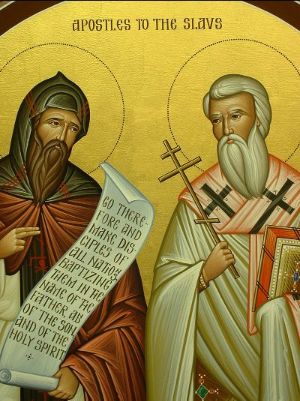
Equals of the Apostles and Teachers of the Slavs, Cyril and Methodius
Commemorated on May 11
(OCA) Saints Cyril and Methodius, Equals of the Apostles, and Enlighteners of the Slavs came from an illustrious and pious family living in the Greek city of Thessalonica. Saint Methodius was the oldest of seven brothers, Saint Constantine [Cyril was his monastic name] was the youngest. At first Saint Methodius was in the military and was governor in one of the Slavic principalities dependent on the Byzantine Empire, probably Bulgaria, which made it possible for him to learn the Slavic language. After living there for about ten years, Saint Methodius later received monastic tonsure at one of the monasteries on Mount Olympus (Asia Minor).
Saint Constantine distinguished himself by his great aptitude, and he studied with the emperor Michael under the finest teachers in Constantinople, including Saint Photius, the future Patriarch of Constantinople (February 6).
Saint Constantine studied all the sciences of his time, and also knew several languages. He also studied the works of Saint Gregory the Theologian. Because of his keen mind and penetrating intellect, Saint Constantine was called “Philosopher” (wise). Upon the completion of his education, Saint Constantine was ordained to the holy priesthood and was appointed curator of the patriarchal library at the church of Hagia Sophia. He soon left the capital and went secretly to a monastery.
Discovered there, he returned to Constantinople, where he was appointed as instructor in philosophy. The young Constantine’s wisdom and faith were so great that he won a debate with Ananias, the leader of the heretical iconclasts. After this victory Constantine was sent by the emperor to discuss the Holy Trinity with the Saracens, and again he gained the victory. When he returned, Saint Constantine went to his brother Saint Methodius on Olympus, spending his time in unceasing prayer and reading the works of the holy Fathers.
The emperor soon summoned both of the holy brothers from the monastery and sent them to preach the Gospel to the Khazars. Along the way they stayed in the city of Korsun, making preparations for their missionary activity. There the holy brothers miraculously discovered the relics of the hieromartyr Clement, Pope of Rome (November 25).
There in Korsun Saint Constantine found a Gospel and Psalter written in Russian letters [i.e. Slavonic], and a man speaking the Slavic tongue, and he learned from this man how to read and speak this language. After this, the holy brothers went to the Khazars, where they won a debate with Jews and Moslems by preaching the Gospel. On the way home, the brothers again visited Korsun and, taking up the relics of Saint Clement, they returned to Constantinople. Saint Constantine remained in the capital, but Saint Methodius was made igumen of the small Polychronion monastery near Mount Olympus, where he lived a life of asceticism as before.
Soon messengers came to the emperor from the Moravian prince Rostislav, who was under pressure from German bishops, with a request to send teachers to Moravia who would be able to preach in the Slavic tongue. The emperor summoned Saint Constantine and said to him, “You must go there, but it would be better if no one knows about this.”
Saint Constantine prepared for the new task with fasting and prayer. With the help of his brother Saint Methodius and the disciples Gorazd, Clement, Savva, Naum and Angelyar, he devised a Slavonic alphabet and translated the books which were necessary for the celebration of the divine services: the Gospel, Epistles, Psalter, and collected services, into the Slavic tongue. This occurred in the year 863.
After completing the translation, the holy brothers went to Moravia, where they were received with great honor, and they began to teach the services in the Slavic language. This aroused the malice of the German bishops, who celebrated divine services in the Moravian churches in Latin. They rose up against the holy brothers, convinced that divine services must be done in one of three languages: Hebrew, Greek or Latin.
Saint Constantine said, “You only recognize three languages in which God may be glorified. But David sang, ‘Praise the Lord, all nations, praise the Lord all peoples (Ps 116/117:1).’ And the Gospel of Saint Matthew (28:18) says, ‘Go and teach all nations....’” The German bishops were humiliated, but they became bitter and complained to Rome.
The holy brothers were summoned to Rome for a decision on this matter. Taking with them the relics of Saint Clement, Saints Constantine and Methodius set off to Rome. Knowing that the holy brothers were bringing these relics with them, Pope Adrian met them along the way with his clergy. The holy brothers were greeted with honor, the Pope gave permission to have divine services in the Slavonic language, and he ordered the books translated by the brothers to be placed in the Latin churches, and to serve the Liturgy in the Slavonic language.
At Rome Saint Constantine fell ill, and the Lord revealed to him his approaching death. He was tonsured into the monastic schema with the name of Cyril. On February 14, 869, fifty days after receiving the schema, Saint Cyril died at the age of forty-two.
Saint Cyril commanded his brother Saint Methodius to continue with their task of enlightening the Slavic peoples with the light of the true Faith. Saint Methodius entreated the Pope to send the body of his brother for burial in their native land, but the Pope ordered the relics of Saint Cyril to be placed in the church of Saint Clement, where miracles began to occur from them.
After the death of Saint Cyril, the Pope sent Saint Methodius to Pannonia, after consecrating him as Archbishop of Moravia and Pannonia, on the ancient throne of Saint Andronicus (July 30). In Pannonia Saint Methodius and his disciples continued to distribute services books written in the Slavonic language. This again aroused the wrath of the German bishops. They arrested and tried Saint Methodius, who was sent in chains to Swabia, where he endured many sufferings for two and a half years.
After being set free by order of Pope John VIII of Rome, and restored to his archdiocese, Saint Methodius continued to preach the Gospel among the Slavs. He baptized the Czech prince Borivoi and his wife Ludmilla (September 16), and also one of the Polish princes. The German bishops began to persecute the saint for a third time, because he did not accept the erroneous teaching about the procession of the Holy Spirit from both the Father and the Son. Saint Methodius was summoned to Rome, but he justified himself before the Pope, and preserved the Orthodox teaching in its purity, and was sent again to the capital of Moravia, Velehrad.
Here in the remaining years of his life Saint Methodius, assisted by two of his former pupils, translated the entire Old Testament into Slavonic, except for the Book of Maccabbees, and even the Nomocanon (Rule of the Holy Fathers) and Paterikon (book of the Holy Fathers).
Sensing the nearness of death, Saint Methodius designated one of his students, Gorazd, as a worthy successor to himself. The holy bishop predicted the day of his death and died on April 6, 885 when he was about sixty years old. The saint’s burial service was chanted in three languages, Slavonic, Greek, and Latin. He was buried in the cathedral church of Velehrad. |
| |
|
Christ is Risen!
After Liturgy we will do a memorial service for all our departed mothers, godmothers, spiritual mothers, grandmothers, aunts, sisters, and daughters. Please submit the names for those you would like commemorated here.
In Christ,
Fr Gregory |
| |
|
Happy Mother's Day!
Happy Mother's Day to all our mothers, godmothers, spiritual mothers, grandmothers, aunts, sisters, and daughters!
God grant you all many years! |
| |
This Week at Ss Cyril & Methodius
Wednesday, May 7
- 11:00 AM-3:00 PM: Office Hours/Confession
Thursday, May 8
- 1:00 PM-5:00 PM: Office Hours/Confession
Saturday, May 10
- 3:00 PM: Catechumen Class
- 5:00 PM: Great Vespers
Sunday, May 11 (Sunday of the Paralytic/Mother's Day)
- 9:00 AM: Hours
- 9:30 AM: Divine Liturgy
|
| |
Looking Ahead
Wednesday, May 14
- 11:00 AM-3:00 PM: Office Hours/Confession
Thursday, May 15
- 1:00 PM-5:00 PM: Office Hours/Confession
Saturday, May 17
- 3:00 PM: Catechumen Class
- 5:00 PM: Great Vespers
Sunday, May 18 (Sunday of the Samaritan Woman)
- 9:00 AM: Hours
- 9:30 AM: Divine Liturgy
|
| |
|
Priest: “Blessed is the Kingdom…”
Choir: “Amen.”
Priest: “Christ is risen… “ (2 ½ times)
Choir: “and upon those in the tombs bestowing life!”
(The Divine Liturgy is begun in this manner until the Leavetaking of Pascha.) |
| |
|
Hymns After the Small Entrance
Tone 3 Troparion (Resurrection)
Let the heavens rejoice! Let the earth be glad! For the Lord has shown strength with His arm. He has trampled down death by death. He has become the first born of the dead. He has delivered us from the depths of hell, and has granted to the world//great mercy.
Glory to the Father, and to the Son, and to the Holy Spirit,
Tone 3 Kontakion (Pentecostarion)
By Thy divine intercession, O Lord, as Thou didst raise up the Paralytic of old, so raise up my soul, paralyzed by sins and thoughtless acts; so that being saved I may sing to Thee://“Glory to Thy power, O compassionate Christ!”
now and ever, and unto ages of ages. Amen.
Tone 8 Kontakion (Pascha)
Thou didst descend into the tomb, O Immortal, Thou didst destroy the power of death. In victory didst Thou arise, O Christ God, proclaiming, “Rejoice!” to the Myrrhbearing Women,//granting peace to Thine Apostles, and bestowing Resurrection on the fallen. |
| |
|
Epistle: Acts 9:32-42
Now it came to pass, as Peter went through all parts of the country, that he also came down to the saints who dwelt in Lydda. There he found a certain man named Aeneas, who had been bedridden eight years and was paralyzed. And Peter said to him, “Aeneas, Jesus the Christ heals you. Arise and make your bed.” Then he arose immediately. So all who dwelt at Lydda and Sharon saw him and turned to the Lord.
At Joppa there was a certain disciple named Tabitha, which is translated Dorcas. This woman was full of good works and charitable deeds which she did. But it happened in those days that she became sick and died. When they had washed her, they laid her in an upper room. And since Lydda was near Joppa, and the disciples had heard that Peter was there, they sent two men to him, imploring him not to delay in coming to them. Then Peter arose and went with them. When he had come, they brought him to the upper room. And all the widows stood by him weeping, showing the tunics and garments which Dorcas had made while she was with them. But Peter put them all out, and knelt down and prayed. And turning to the body he said, “Tabitha, arise.” And she opened her eyes, and when she saw Peter she sat up. Then he gave her his hand and lifted her up; and when he had called the saints and widows, he presented her alive. And it became known throughout all Joppa, and many believed on the Lord.
Gospel: John 5:1-15
After this there was a feast of the Jews, and Jesus went up to Jerusalem. Now there is in Jerusalem by the Sheep Gate a pool, which is called in Hebrew, Bethesda, having five porches. In these lay a great multitude of sick people, blind, lame, paralyzed, waiting for the moving of the water. For an angel went down at a certain time into the pool and stirred up the water; then whoever stepped in first, after the stirring of the water, was made well of whatever disease he had. Now a certain man was there who had an infirmity thirty-eight years. When Jesus saw him lying there, and knew that he already had been in that condition a long time, He said to him, “Do you want to be made well?”
The sick man answered Him, “Sir, I have no man to put me into the pool when the water is stirred up; but while I am coming, another steps down before me.”
Jesus said to him, “Rise, take up your bed and walk.” And immediately the man was made well, took up his bed, and walked.
And that day was the Sabbath. The Jews therefore said to him who was cured, “It is the Sabbath; it is not lawful for you to carry your bed.”
He answered them, “He who made me well said to me, ‘Take up your bed and walk.’ ”
Then they asked him, “Who is the Man who said to you, ‘Take up your bed and walk’?” But the one who was healed did not know who it was, for Jesus had withdrawn, a multitude being in that place. Afterward Jesus found him in the temple, and said to him, “See, you have been made well. Sin no more, lest a worse thing come upon you.”
The man departed and told the Jews that it was Jesus who had made him well.
++++++++++++++++++++++++++++++
(Instead of “It is truly meet…,” we sing:)
The Angel cried to the Lady, full of grace:
“Rejoice, O pure Virgin! Again, I say: Rejoice,
thy Son is risen from His three days in the tomb!
With Himself He has raised all the dead.”
Rejoice, O ye people!
Shine, shine, O new Jerusalem!
The glory of the Lord has shone on thee.
Exult now, and be glad, O Zion!
Be radiant, O pure Theotokos,
in the Resurrection of thy Son!
Communion Hymn
Praise the Lord, O Jerusalem! Praise thy God, O Zion! (Ps. 147:1)
Alleluia, Alleluia, Alleluia!
Priest: “In the fear of God…”
Choir: “Blessed is He that comes in the Name of the Lord… “
Priest: “O God, save Thy people… “
Choir: “Christ is risen from the dead… “ (sung once, instead of “We have seen the True Light…)
Priest: “Always, now and ever…”
Choir: “Let our mouths be filled…”
DISMISSAL
Priest: The blessing of the Lord be upon you…”
Choir: Amen.
Priest: Glory to Thee, O Christ…
Priest: Christ is risen from the dead, trampling down death by death,...
Choir: …and upon those in the tombs bestowing life!”
Priest: May He Who rose from the dead, Christ our true God,... Choir: Amen.
Priest: CHRIST IS RISEN! (x3)
People: INDEED HE IS RISEN! (After each)
Choir: Christ is risen from the dead, trampling down death by death, and upon those in the tombs bestowing life! (x3)
And unto us hath He granted life eternal; we worship His Resurrection on the third day. |
| |
|
By the age of 25, about 60% of those baptized as infants will no longer consider themselves members of the Orthodox Church. A parish on a university campus is an important witness not only to the surrounding community but also to high school age and younger parishioner. Establishing a parish on the campus of the University of Wisconsin-Madison helps remind young people that graduating high school doesn't mean "graduating" from the Church. Please consider joining those who have committed their time, treasure and talent in establishing an Orthodox community on the Isthmus.
Please help us reach your children and grandchildren with the Gospel of Jesus Christ by clicking the gofundme link. |
| |
|