|
1020 Regent St
(Lower Level)
Madison, WI 53715
(608) 819-6505
|
| |
|
Click above to send names of those to be commemorated at Liturgy. |
| |
March 16, 2025
Tone 5
Second Sunday of Great Lent
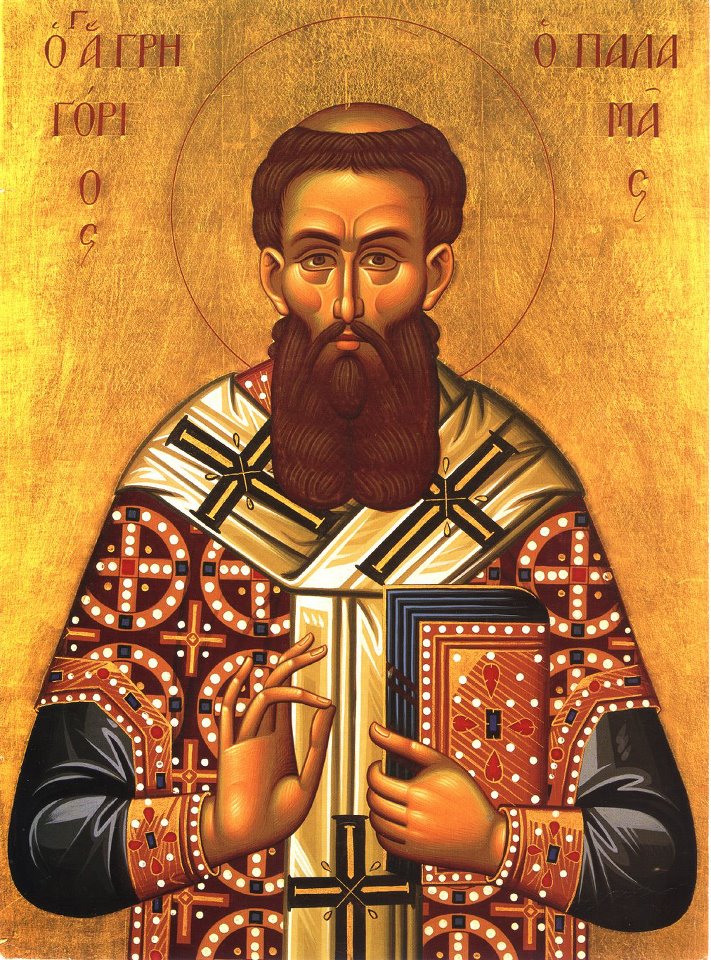
St. Gregory Palamas |
| |
Second Sunday of Great Lent: St. Gregory Palamas
Commemorated on March 16
(OCA) This Sunday was originally dedicated to Saint Polycarp of Smyrna (February 23). After his glorification in 1368, a second commemoration of Saint Gregory Palamas (November 14) was appointed for the Second Sunday of Great Lent as a second “Triumph of Orthodoxy.”
Saint Gregory Palamas, Archbishop of Thessalonica, was born in the year 1296 in Constantinople. Saint Gregory’s father became a prominent dignitiary at the court of Andronicus II Paleologos (1282-1328), but he soon died, and Andronicus himself took part in the raising and education of the fatherless boy. Endowed with fine abilities and great diligence, Gregory mastered all the subjects which then comprised the full course of medieval higher education. The emperor hoped that the youth would devote himself to government work. But Gregory, barely twenty years old, withdrew to Mount Athos in the year 1316 (other sources say 1318) and became a novice in the Vatopedi monastery under the guidance of the monastic Elder Saint Νikόdēmos of Vatopedi (July 11). There he was tonsured and began on the path of asceticism. A year later, the holy Evangelist John the Theologian appeared to him in a vision and promised him his spiritual protection. Gregory’s mother and sisters also became monastics.
After the demise of the Elder Νikόdēmos, Saint Gregory spent eight years of spiritual struggle under the guidance of the Elder Nikēphóros, and after the latter’s death, Gregory transferred to the Lavra of Saint Athanasius (July 5). Here he served in the trapeza, and then became a church singer. But after three years, he resettled in the small skete of Glossia, striving for a greater degree of spiritual perfection. The head of this monastery began to teach the young man the method of unceasing prayer and mental activity, which had been cultivated by monastics, beginning with the great desert ascetics of the fourth century: Evagrius Pontikos and Saint Macarius of Egypt (January 19).
Later on, in the eleventh century Saint Simeon the New Theologian (March 12) provided detailed instruction in mental activity for those praying in an outward manner, and the ascetics of Athos put it into practice. The experienced use of mental prayer (or prayer of the heart), requiring solitude and quiet, is called “Hesychasm” (from the Greek “hesychia” meaning calm, silence), and those practicing it were called “hesychasts.”
During his stay at Glossia the future hierarch Gregory became fully embued with the spirit of hesychasm and adopted it as an essential part of his life. In the year 1326, because of the threat of Turkish invasions, he and the brethren retreated to Thessalonica, where he was then ordained to the holy priesthood.
Saint Gregory combined his priestly duties with the life of a hermit. Five days of the week he spent in silence and prayer, and only on Saturday and Sunday did he come out to his people. He celebrated divine services and preached sermons. For those present in church, his teaching often evoked both tenderness and tears. Sometimes he visited theological gatherings of the city’s educated youth, headed by the future patriarch, Isidore. After he returned from a visit to Constantinople, he found a place suitable for solitary life near Thessalonica the region of Bereia. Soon he gathered here a small community of solitary monks and guided it for five years.
In 1331 the saint withdrew to Mt. Athos and lived in solitude at the skete of Saint Savva, near the Lavra of Saint Athanasius. In 1333 he was appointed Igumen of the Esphigmenou monastery in the northern part of the Holy Mountain. In 1336 the saint returned to the skete of Saint Savva, where he devoted himself to theological works, continuing with this until the end of his life.
In the 1330s events took place in the life of the Eastern Church which put Saint Gregory among the most significant universal apologists of Orthodoxy, and brought him great renown as a teacher of hesychasm.
About the year 1330 the learned monk Barlaam had arrived in Constantinople from Calabria, in Italy. He was the author of treatises on logic and astronomy, a skilled and sharp-witted orator, and he received a university chair in the capital city and began to expound on the works of Saint Dionysius the Areopagite (October 3), whose “apophatic” (“negative”, in contrast to “kataphatic” or “positive”) theology was acclaimed in equal measure in both the Eastern and the Western Churches. Soon Barlaam journeyed to Mt. Athos, where he became acquainted with the spiritual life of the hesychasts. Saying that it was impossible to know the essence of God, he declared mental prayer a heretical error. Journeying from Mount Athos to Thessalonica, and from there to Constantinople, and later again to Thessalonica, Barlaam entered into disputes with the monks and attempted to demonstrate the created, material nature of the light of Tabor (i.e. at the Transfiguration). He ridiculed the teachings of the monks about the methods of prayer and about the uncreated light seen by the hesychasts.
Saint Gregory, at the request of the Athonite monks, replied with verbal admonitions at first. But seeing the futility of such efforts, he put his theological arguments in writing. Thus appeared the “Triads in Defense of the Holy Hesychasts” (1338). Towards the year 1340 the Athonite ascetics, with the assistance of the saint, compiled a general response to the attacks of Barlaam, the so-called “Hagiorite Tome.” At the Constantinople Council of 1341 in the church of Hagia Sophia Saint Gregory Palamas debated with Barlaam, focusing upon the nature of the light of Mount Tabor. On May 27, 1341 the Council accepted the position of Saint Gregory Palamas, that God, unapproachable in His Essence, reveals Himself through His energies, which are directed towards the world and are able to be perceived, like the light of Tabor, but which are neither material nor created. The teachings of Barlaam were condemned as heresy, and he himself was anathemized and fled to Calabria.
But the dispute between the Palamites and the Barlaamites was far from over. To these latter belonged Barlaam’s disciple, the Bulgarian monk Akyndinos, and also Patriarch John XIV Kalekos (1341-1347); the emperor Andronicus III Paleologos (1328-1341) was also inclined toward their opinion. Akyndinos, whose name means “one who inflicts no harm,” actually caused great harm by his heretical teaching. Akyndinos wrote a series of tracts in which he declared Saint Gregory and the Athonite monks guilty of causing church disorders. The saint, in turn, wrote a detailed refutation of Akyndinos’ errors. The patriarch supported Akyndinos and called Saint Gregory the cause of all disorders and disturbances in the Church (1344) and had him locked up in prison for four years. In 1347, when John the XIV was replaced on the patriarchal throne by Isidore (1347-1349), Saint Gregory Palamas was set free and was made Archbishop of Thessalonica.
In 1351 the Council of Blachernae solemnly upheld the Orthodoxy of his teachings. But the people of Thessalonica did not immediately accept Saint Gregory, and he was compelled to live in various places. On one of his travels to Constantinople the Byzantine ship fell into the hands of the Turks. Even in captivity, Saint Gregory preached to Christian prisoners and even to his Moslem captors. The Hagarenes were astonished by the wisdom of his words. Some of the Moslems were unable to endure this, so they beat him and would have killed him if they had not expected to obtain a large ransom for him. A year later, Saint Gregory was ransomed and returned to Thessalonica.
Saint Gregory performed many miracles in the three years before his death, healing those afflicted with illness. On the eve of his repose, Saint John Chrysostom appeared to him in a vision. With the words “To the heights! To the heights!” Saint Gregory Palamas fell asleep in the Lord on November 14, 1359. In 1368 he was canonized at a Constantinople Council under Patriarch Philotheus (1354-1355, 1364-1376), who compiled the Life and Services to the saint. |
| |
|
Glory to Jesus Christ!
Thank you to everyone who helped with last week with Compline and the Canon of St. Andrew!
The Liturgy of the Presanctified Gifts is this Wednesday at 6 p.m. If you are planning on receiving holy communion, please fast after lunch.
Akathist to Our Lady Queen of All will be served this Thursday at 5:30. Please submit the names of those you wish remembered here.
Akathist to the Passion of Christ will be sung, on Friday at Noon.
Inquirers/Catechumen classes will continue discussing chapter 3: "The One God: Father and Creator," in Catechism: A Short Guide to Orthodox Christianity by Metropolitan Hilarion (Alfeyev). If someone you know (or you!) is interested in learning more about the Gospel, the faith of the Church, and what it means to be a disciple of Christ, this is the class.
In Christ,
Fr Gregory |
| |
|
The Prayer of St. Ephrem: A Practical Guide of Archbishop Daniel to Spiritual Renewal and Transformation: Part I
|
| |
|
Among the many prayers in Orthodox Christian tradition, few are as spiritually profound and transformative as the Prayer of St. Ephraim the Syrian. This prayer, recited frequently during Great Lent, is a roadmap to repentance, humility, and renewal, making it one of the most beloved and essential prayers of the Orthodox faith. Though short in length, it carries within it a comprehensive guide for overcoming sin and acquiring virtue, serving as a mirror for self-examination and a ladder toward spiritual ascent.
Every year during Great Lent, Orthodox Christians prostrate themselves as they recite this prayer, embodying its words through physical humility. But this prayer is not meant to be limited to the Lenten season - it is a lifelong guide for the soul, challenging us to examine our hearts and turn toward Christ with sincerity and repentance.
The author of this prayer, St. Ephraim the Syrian (c. 306–373 AD), was one of the most remarkable spiritual fathers of the early Church. Born in Nisibis (modern-day Turkey), St. Ephraim was a deacon, theologian, poet, and ascetic, known for his deep spiritual insight and eloquence. His writings, particularly his hymns and prayers, played a crucial role in shaping Christian spirituality.
Despite his vast influence, St. Ephraim remained deeply humble. He refused the priesthood and chose instead to serve as a deacon, dedicating his life to prayer, fasting, and instructing others in the faith. His writings were not only theological but also deeply poetic and filled with imagery, making them accessible to both the learned and the simple.
St. Ephraim’s hymns and prayers often focus on the themes of repentance, divine mercy, and the battle against sin. His words continue to inspire Christians today, guiding them toward a life of holiness. The Prayer of St. Ephraim is perhaps his most well-known spiritual work, a powerful call to repentance that has been embraced by the Orthodox Church for over 1,600 years.
Why is this prayer so closely associated with Great Lent? Lent is a time of spiritual struggle, a period when the Church calls every believer to self-examination, humility, and repentance. This prayer perfectly encapsulates the Lenten mindset - not just sorrow for sin, but an active desire to be transformed by God’s grace.
Each line of this prayer identifies key spiritual dangers - sloth, despair, lust for power, and idle talk - while also calling upon God to fill the soul with chastity, humility, patience, and love. It is a battle cry against the passions, a plea for healing, and an invitation to live a life of holiness.
But this prayer is not only relevant during Lent. It is a daily challenge - a call to constantly renew our hearts, to resist the forces that pull us away from God, and to actively cultivate the virtues that bring us closer to Him.
As we explore this prayer in detail, let us remember that its purpose is not just to be recited but to be lived. It is a prayer that, if taken seriously, can transform our thoughts, actions, and entire spiritual life.
Let us now break down each section, uncovering its meaning and how it can be practically applied in our journey toward holiness.
To be continued... |
| |
This Week at Ss Cyril & Methodius
Wednesday, March 12
- 1:00 PM-5:00 PM: Office Hours/Confessions
- 6:00 PM: Pre-Sanctified Liturgy
Thursday, March 13
- 1:00 PM-5:00 PM: Office Hours/Confession
- 5:30 PM: Akathist our Lady Queen of All (submit names here)
- 6:00 PM: OCF Meeting
Friday, March 14
- Noon: Akathist to the Passion of Christ
Saturday, March 15
- 3:00 PM: Inquirers/Catechumen Class
- 5:00 PM: Great Vespers
- 6:00 PM: Confessions
Sunday, March 16 (Sunday of St. Gregory Palamas)
- 9:00 AM: Hours
- 9:30 AM: Divine Liturgy
- OCF sponsored coffee hour
|
| |
Looking Ahead to Next Week
Wednesday, March 19
- 1:00 PM-5:00 PM: Office Hours/Confessions
- 6:00 PM: Pre-Sanctified Liturgy
Thursday, March 20
- 1:00 PM-5:00 PM: Office Hours/Confession
- 6:00 PM: OCF Meeting
Friday, March 21
- Noon: Akathist to the Passion of Christ
Saturday, March 22
- 3:00 PM: Inquirers/Catechumen Class
- 5:00 PM: Great Vespers
- 6:00 PM: Confessions
Sunday, March 23 (Sunday of the Cross)
- 9:00 AM: Hours
- 9:30 AM: Divine Liturgy
|
| |
Hymns After the Small Entrance
Tone 5 Troparion (Resurrection)
Let us, the faithful, praise and worship the Word, co-eternal with the Father and the Spirit, born for our salvation from the Virgin; for He willed to be lifted up on the Cross in the flesh, to endure death, and to raise the dead//by His glorious Resurrection.
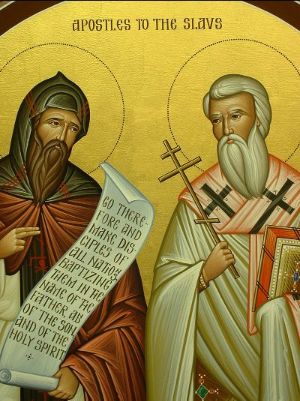
Tone 4 Troparion (Sts. Cyril & Methodius)
Divinely-wise Cyril and Methodius, / equals-to-the-apostles and teachers of the Slavs, / entreat the Master of all / to strengthen all nations in Orthodoxy and unity of mind, / to grant peace to the world and to save our souls.
Tone 8 Troparion (St. Gregory Palamas)
O light of Orthodoxy, teacher of the Church, its confirmation, O ideal of monks and invincible champion of theologians, O wonderworking Gregory, glory of Thessalonica and preacher of grace,//always intercede before the Lord that our souls may be saved!
Tone 3 Kontakion (Sts. Cyril & Methodius)
Let us honor the sacred pair, who translated divine scripture / pouring forth a fountain of divine knowledge from which we still draw today. / Now as you stand before the throne of the Most-high / we call you blessed, Cyril and Methodius, / as you fervently pray for our souls.
Glory to the Father, and to the Son, and to the Holy Spirit,
Tone 8 Kontakion (St. Gregory Palamas)
Holy and divine instrument of wisdom, joyful trumpet of theology, together we sing thy praises, O God-inspired Gregory. Since thou now standest before the Original Mind, guide our minds to Him, O Father,//so that we may sing to thee: “Rejoice, preacher of grace!”
now and ever, and unto ages of ages. Amen.
Tone 4 Kontakion (from the Lenten Triodion)
Now is the time for action! Judgment is at the doors! So let us rise and fast, offering alms with tears of compunction and crying: “Our sins are more in number than the sands of the sea; but forgive us, O Master of all,//so that we may receive the incorruptible crowns!” |
| |
|
Epistle: Hebrews 1:10-2:3
Brethren,
“You, Lord, in the beginning laid the foundation of the earth,
And the heavens are the work of Your hands.
They will perish, but You remain;
And they will all grow old like a garment;
Like a cloak You will fold them up,
And they will be changed.
But You are the same,
And Your years will not fail.”
But to which of the angels has He ever said:
“Sit at My right hand,
Till I make Your enemies Your footstool”?Are they not all ministering spirits sent forth to minister for those who will inherit salvation?
Therefore we must give the more earnest heed to the things we have heard, lest we drift away. For if the word spoken through angels proved steadfast, and every transgression and disobedience received a just reward, how shall we escape if we neglect so great a salvation, which at the first began to be spoken by the Lord, and was confirmed to us by those who heard Him.
Gospel: Mark 2:1-12
And again He entered Capernaum after some days, and it was heard that He was in the house. Immediately many gathered together, so that there was no longer room to receive them, not even near the door. And He preached the word to them. Then they came to Him, bringing a paralytic who was carried by four men. And when they could not come near Him because of the crowd, they uncovered the roof where He was. So when they had broken through, they let down the bed on which the paralytic was lying.
When Jesus saw their faith, He said to the paralytic, “Son, your sins are forgiven you.”
And some of the scribes were sitting there and reasoning in their hearts, “Why does this Man speak blasphemies like this? Who can forgive sins but God alone?”
But immediately, when Jesus perceived in His spirit that they reasoned thus within themselves, He said to them, “Why do you reason about these things in your hearts? Which is easier, to say to the paralytic, ‘Your sins are forgiven you,’ or to say, ‘Arise, take up your bed and walk’? But that you may know that the Son of Man has power on earth to forgive sins”—He said to the paralytic, “I say to you, arise, take up your bed, and go to your house.” Immediately he arose, took up the bed, and went out in the presence of them all, so that all were amazed and glorified God, saying, “We never saw anything like this!”
++++++++++++++++++++++++++++
(Instead of “It is truly meet…,” we sing the following)
Hymn to the Theotokos
All of creation rejoices in thee, O Full of Grace:
the assembly of angels and the race of men.
O sanctified temple and spiritual paradise,
the glory of virgins,
from whom God was incarnate and became a Child:
our God before the ages.
He made thy body into a throne,
and thy womb He made more spacious than the heavens.
All of creation rejoices in thee, O Full of Grace.//
Glory to thee! |
| |
|
By the age of 25, about 60% of those baptized as infants will no longer consider themselves members of the Orthodox Church. A parish on a university campus is an important witness not only to the surrounding community but also to high school age and younger parishioner. Establishing a parish on the campus of the University of Wisconsin-Madison helps remind young people that graduating high school doesn't mean "graduating" from the Church. Please consider joining those who have committed their time, treasure and talent in establishing an Orthodox community on the Isthmus.
Please help us reach your children and grandchildren with the Gospel of Jesus Christ by clicking the gofundme link. |
| |
|