|
1020 Regent St
(Lower Level)
Madison, WI 53715
|
| |
|
Click above to send names of those to be commemorated at Liturgy. |
| |
|
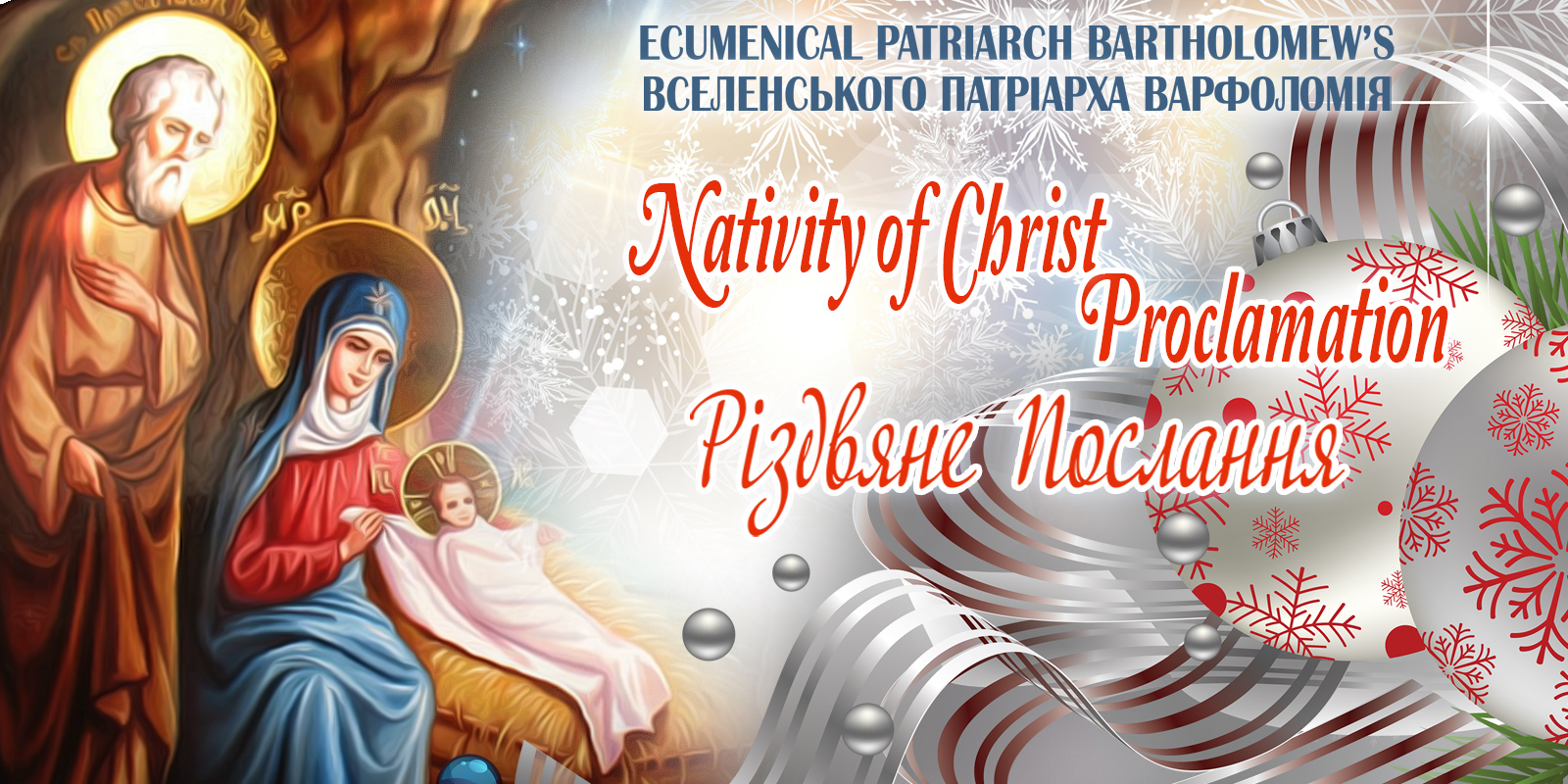
Patriarchal Proclamation for the Nativity of Christ |
| |
|
+ B A R T H O L O M E W
BY GOD’S MERCY ARCHBISHOP OF CONSTANTINOPLE-NEW ROME
AND ECUMENICAL PATRIARCH
TO ALL THE PLENITUDE OF THE CHURCH
GRACE, MERCY AND PEACE
FROM THE SAVIOR CHRIST BORN IN BETHLEHEM
Most honorable brother hierarchs and blessed children in the Lord,
With the grace from above, we have once again this year arrived at the festal day of the Nativity in the flesh of God the Word, who came into the world and dwelt among us “out of his ineffable loving for humankind.” We honor with psalms and hymns as well as with inexpressible joy the great mystery of the Incarnation, which is “newer than everything new, the only new thing under the sun,”[1] through which the way is opened for us to deification by grace and the entire creation is renewed. Christmas is not the experience of emotions that “come rapidly and depart even more rapidly.” It is the existential participation in the whole event of Divine Economy. As testified by the Evangelist Matthew (ch. 1. 18–2.1-23), the leaders of the world sought to obliterate the divine infant from the outset. For us faithful, along with the cry that “Christ is born” in the feast of the incarnation of the Son and Word of God the Father, as well as the mournful bells of His passion, we also hear the cry that “Christ is risen,” the good news of the victory over death and expectation of the common resurrection.
The words “Glory to God in the highest and on earth peace” are heard once more in a world filled with violence, social injustice and dissolution of human dignity. The stunning progress of science and technology does not reach the depth of the human soul, because human beings are always more than what science can comprehend or to which the advancement of technology aspires. The gap between heaven and earth in our human existence cannot be scientifically bridged.
Today there is much talk about “the metahuman” and praise of artificial intelligence. The dream of “the superhuman” is of course hardly new. The concept of “the metahuman” is based on technological progress and his equipment with means previously unimaginable to human experience and history, through which humankind will be able to transcend currently valid human measures. The Church is not technophobic. It approaches scientific knowledge as “a divinely granted gift to human beings,” without however overlooking or suppressing the dangers of scientism. The Encyclical of the Holy and Great Council of the Orthodox Church (Crete, 2016) also emphasizes the contribution of Christianity “to the healthy development of secular civilization,” since God “established human beings as stewards of sacred creation and His coworkers in the world.” Moreover, it also highlights: “The Orthodox Church sets against the ‘man-god’ of the contemporary world the ‘God-man’ as the ultimate measure of all things. “We do not speak of a man who has been deified, but of God who has become man (John of Damascus, An Exact Exposition of the Orthodox Faithiii, 2 PG 94.988).”[2]
The answer to the crucial question—namely, how can we preserve the “culture of personhood,” the respect for its sacredness and emphasis on its beauty, until the final “eighth day” in the face of the titanism and prometheanism of the technological culture, its evolution and transmutation, in the midst of anthropotheistic changes and exaggerations of humankind—has been given once for all in the mystery of Divine Humanity. God the Word became flesh, the “truth has come” and “the shadow has passed.” For human beings, speaking the truth will forevermore be associated with their relationship to God as the response to God’s descent toward them and as the expectation and encounter of the coming Lord of glory. This living faith supports the human struggle to respond to the contradictions and challenges of earthly life, to life “by bread” (Mt 4.4), to survival as well as social and cultural development. Nevertheless, nothing in our life can thrive without reference to God, without the horizon of “the fullness of life, the fullness of joy and the fullness of knowledge” of His Kingdom.[3]
Christmas is an opportunity for us to become conscious of the mystery of divine freedom and the great miracle of human freedom. Christ knocks on the door of the human heart, yet only human beings honored with such freedom are able to open that door. “Clearly, without Him, without Christ,” as the late Fr. Georges Florovsky writes, “man cannot do anything. But there is something that only man can do—namely, respond to God’s call and welcome Christ.”[4]
By saying “Yes” to this calling from above, Christ is revealed as “the true light” (Jn 1.9), “the way, the truth and the life” (Jn 14.6), the answer to the ultimate questions and pursuits of the intellect, to the desires of the heart and the hopes of humankind, but also to the “whence” and “whereto” of creation. We belong to Christ, in Whom all things are united. Christ is “the Alpha and Omega, the first and the last, the beginning and the end” (Rev. 22.13). In His voluntary incarnation “for us men and for our salvation,” the Word of God “did not dwell in a single human being, but embraced human nature in its entirety with His hypostasis,”[5] thereby establishing the common eternal destiny and unity of humanity. He does not liberate one people, but the entire race of humankind; He does not savingly divide only history, but renews the whole creation. Just as for history, so too for the universe, “before Christ” and “after Christ” holds definitively and determinately valid. Throughout its journey in the world, in history and through it to the Eschata, to the day without setting in the heavenly Kingdom of the Father, the Son and the Holy Spirit, the Church that is “not in the world” witnesses to the truth and performs its sanctifying and spiritual work “for the life of the world.”
Brethren and children in the Lord,
With a spirit of devotion, we kneel before the Mother of God who holds the infant and humbly worship “the Word from the beginning” who assumed our form, and we wish to all of you a blessed and holy Twelvetide and a favorable, healthy, peaceful and fruitful in good deeds new year of the Lord’s favor, filled with spiritual joy and divine gifts, in which the entire Christian world concelebrates and honors the 1700th anniversary of the First Ecumenical Council of Nicaea.
Christmas 2024
+Bartholomew of Constantinople
Fervent supplicant of you all before God
--------------------------------------------
To be read in churches after the Gospel Reading during the Divine Liturgy on the Feast of Christmas.
[1] John of Damascus, An Exact Exposition of the Orthodox Faith, PG 94.984.
[2] Encyclical, § 10.
[3] Alexander Schmemann, I believe (Athens: Akritas Editions, 1991), 129 [from the Greek].
[4] Georges Florovsky, Creation and Redemption (Thessaloniki: Pournaras Editions, 1983) [from the Greek].
[5] Nicholas Cabasilas, Nine Unpublished Homilies (Thessaloniki, 1976), 108. |
| |
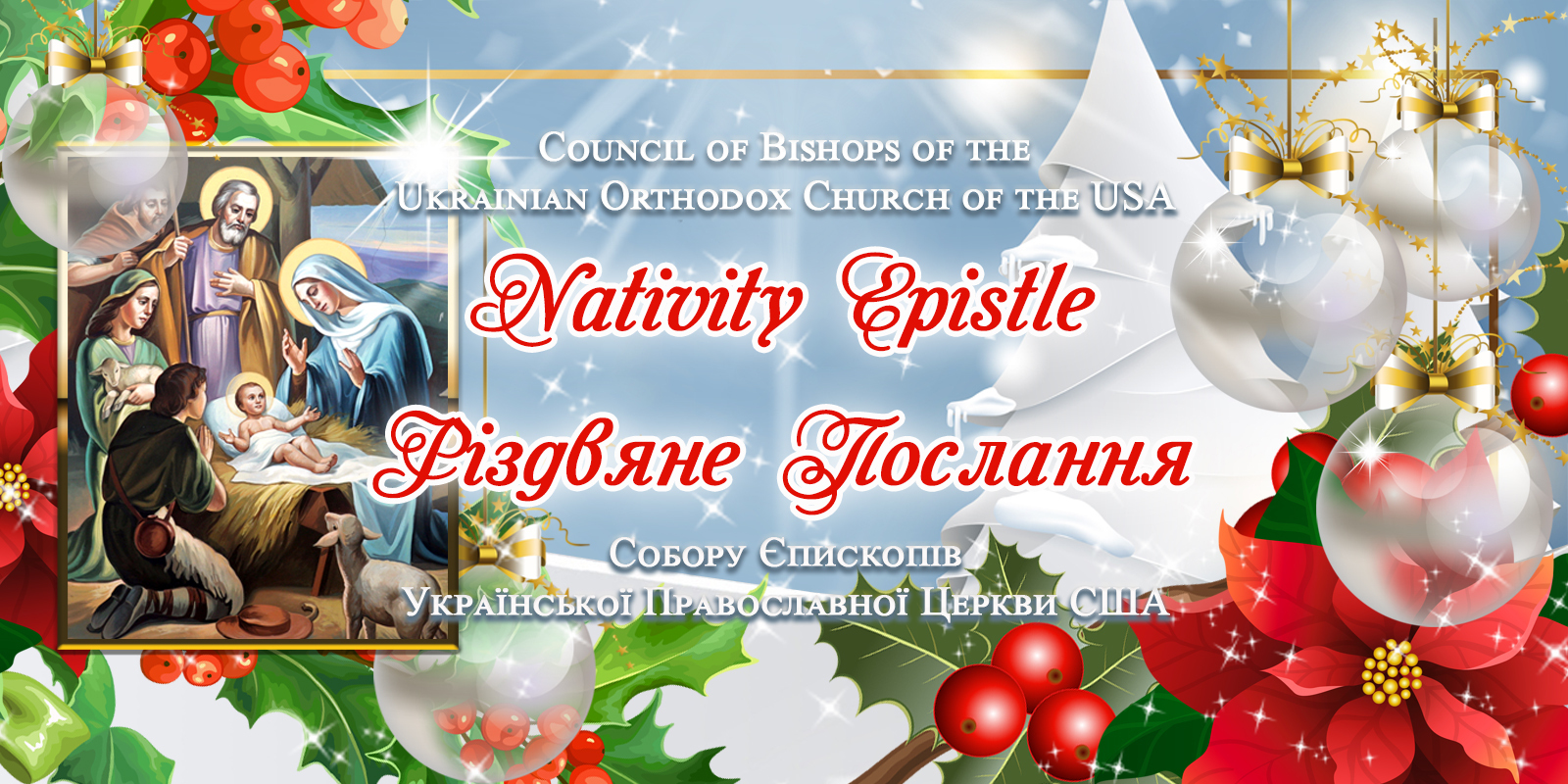
Archpastoral Christmas Letter of the Council of Bishops of the UOC of the USA and Diaspora |
| |
|
To the Clergy and Faithful in the USA, Australia, New Zealand, Western Europe, and South America
Beloved Brothers and Sisters in Christ,
CHRIST IS BORN! GLORIFY HIM!
As we gather in the radiant light of the Nativity of our Lord and Savior Jesus Christ, our hearts are warmed with the joy of this sacred season. We rejoice in the birth of Emmanuel—God with us—who entered our world to bring salvation, hope, and peace to all. This holy celebration coincides with the conclusion of the year 2024 and the dawn of 2025, a new year of God’s grace. Together, let us reflect upon the blessings of the past year and prepare to welcome the coming year with faith, love, and a renewed commitment to walk in the light of Christ. The Lord’s Nativity reminds us that His grace is ever-present, calling us to enter into the new year striving for peace and reaching out with love to the darkest corners of our world – most especially to Ukraine. In a society often marked by division and a culture of isolation, Christ came to unite us, to transform us back to our original dignity as children of God. His Incarnation is a call to rebuild relationships, foster community, and reflect the love of our Creator in our daily lives.
The Nativity season is also a time to celebrate the timeless traditions that define our Ukrainian Orthodox faith and culture. The Holy Supper (Sviata Vecheria) brings families together in sacred gatherings that span generations—grandparents, parents, and children united in prayer and thanksgiving. These cherished customs, passed down through the centuries, proclaim the joyful message of Christ’s Nativity and remind us of our shared identity as His people. The singing of traditional carols (kolyadky), with their proclamations of the Savior’s coming, strengthens our bonds of faith and brings the Light of the Nativity into our homes and communities.
We encourage you, dear faithful, to preserve these sacred traditions and pass them on to future generations. Sing the carols, prepare the Holy Supper, and greet one another with the timeless proclamation: “Christ is Born! Glorify Him!” These acts of faith and love testify to the enduring presence of Christ in our lives. As we reflect on the journey of Christ’s life - from the manger to the cross - we are called to enter into His joy and to walk with Him along the path of salvation. The history of salvation, which began in the humble manger, leads us through the ultimate sacrifice on the Cross to the eternal glory of His Resurrection. Let this sacred journey inspire us to live as His faithful disciples, embracing His call to holiness and service.
Amid the coldness of the world, marked by war and suffering, the faithful in Ukraine offer us a profound example of perseverance and faith. In the face of war, lack of electricity, lack of heat and disrupted lives, they gather in basements and shelters, singing carols and celebrating the Nativity with hearts warmed by the Light of Christ. We join them in spirit, praying for peace in Ukraine and for all those enduring hardship in other war-torn areas of the world.
The Prince of Peace entered the world to call us to be instruments of His peace. Let us dedicate ourselves to this divine mission, praying and working for reconciliation and healing in our communities and throughout the world. As we celebrate the Nativity, we also reaffirm our commitment to the sanctity of human life, from conception to natural death, and to the dignity of every person as a child of God.
Beloved in Christ, may the joy and warmth of this holy season fill your hearts and homes. Let us proclaim together: “God is with us! Who can be against us?” By sharing the Light of Christ - the Newborn King - we can bring hope and love to a world in need.
CHRIST IS BORN! GLORIFY HIM!
With Archpastoral Blessings,
+Metropolitan Antony
+Archbishop Jeremiah
+Archbishop Daniel |
| |
|
Різдвяне Послання Вселенського Патріарха |
| |
|
+ Варфоломій,
Милістю Божою Архиєпископ Константинопольський, Нового Риму
і Вселенський Патріарх,
Усій повноті Церкви,
Благодать, милість і мир
Від Христа Спасителя народженого у Вифлеємі
Всечесні браття ієрархи і благословенні чада в Господі,
З благодаті з висоти ми знову дійшли цього року до свята Різдва у плоті Бога Слова, який прийшов у світ і оселився між нами «з невимовного людинолюбства». Ми вшановуємо псалмами і піснями духовними з невимовною радістю велику таємницю Боговтілення, яке є «новіше за все нове, єдине нове під сонцем»[1], через яке відкривається нам шлях до обожнення благодаттю і через яке все творіння оновлюється. Різдво — це не досвід емоцій, які «швидко приходять і ще швидше відходять». Це екзистенційна участь у всій події Божественної Ікономії. Як свідчить євангелист Матвій[2], начальники світу прагнули з самого початку знищити Божественне немовля. Для нас, вірних, разом із вигуком «Христос народився» у свято воплочення Сина і Слова Бога Отця, а також скорботними дзвонами Його страстей, ми чуємо також вигук «Христос воскрес», добра звістка про перемогу над смертю та очікування спільного воскресіння.
Слова «Слава во вишніх Богу, і на землі мир» знову лунають у світі, сповненому насильства, соціальної несправедливости та розпаду людської гідности. Приголомшливий прогрес науки і техніки не досягає глибини людської душі, тому що люди завжди є чимось більшим, ніж те, що може осягнути наука або до чого прагне прогрес техніки. Прірва між небом і землею в нашому людському існуванні не може бути подолана наукою.
Сьогодні багато говорять про «металюдину» і вихваляють штучний інтелект. Мрія про «надлюдину», звичайно, навряд чи нова. Концепція «металюдини» базується на технологічному прогресі та його оснащенні засобами, які раніше було неможливо уявити в людському досвіді та історії, за допомогою яких людство зможе вийти за межі чинних людських мірок. Церква не технофобна. Вона розглядає наукові знання як «божественний дар людям», однак не випускає з уваги та не приховує небезпек сцієнтизму. Окружне послання Святого і Великого Собору Православної Церкви (Крит, 2016) також наголошує на внеску християнства «в здоровий розвиток світської цивілізації загалом», оскільки Бог «поставив людину управителем священного творіння і його співпрацівником у світі». Крім того, тут також підкреслюється: «Замість сучасного «людинобога» Православна Церква утверджує Боголюдину як остаточну міру всього. «Ми говоримо не про обожнену людину, а про Бога, Який став людиною» (Йоан Дамаскин, Точне викладення православної віри, 3, 2, PG 94, 988)»[3].
Відповідь на ключове питання, а саме, як ми можемо зберегти «культуру особистости», повагу до її святости та наголошення на її красі, до останнього «восьмого дня» перед лицем титанізму та прометеїзму технічної культури, її еволюції й трансмутації, серед антропотеїстичних змін і перебільшень людства, — було дано раз назавжди в таємниці Боголюдства. Бог Слово став тілом, «правда прийшла» і «тінь пройшла». У вічності те, що є істинним для людини, буде пов’язане з її стосунками з Богом, як відповідь на Боже сходження до неї та як очікування й зустріч із прийдешнім Господом слави. Ця жива віра підтримує боротьбу людини, щоб відповісти на суперечності та виклики її земного життя, життя «хлібом»[4], виживання та соціально-культурного розвитку. Однак ніщо в нашому житті не процвітає без уповання на Бога, що визначає «повноту життя, повноту радости та повноту пізнання» Його Царства[5].
Різдво є для нас нагодою усвідомити таємницю Божої волі та велике чудо свободи людини. Христос стукає у двері людського серця, але ті двері можуть відчинити лише люди, удостоєні такої свободи. «Звичайно, без Нього, без Христа людина нічого не може зробити. Але є те, що може зробити лише людина, а саме: відповісти на Божий заклик і прийняти Христа», – писав блаженної пам’яти о. Георгій Флоровський[6].
Відповівши «Так» цьому покликанню з висоти, Христос відкривається як «правдиве світло»[7], як «дорога, істина і життя»[8], як відповідь на найголовніші питання та пошуки інтелекту до бажань серця і надій людства, але також відповідей творіння на питання: «звідки» і «куди». Ми належимо до Христа, в Якому все об’єднано. Христос є «Альфа і Омега, перший і останній, початок і кінець»[9]. У Своєму добровільному втіленні «для нас людей і для нашого спасіння» Слово Боже «не перебувало в одній людині, але охопило людську природу, в її повноті, Своєю Іпостассю»[10], тим самим встановивши спільну вічну долю та єдність людства. Він визволяє не один народ, а весь рід людський. Він не тільки розділяє історію ради спасіння, але й оновлює все творіння. Як і для історії, так і для всесвіту, слова «до Христа» і «після Христа» є однозначно й остаточно дійсними. Церква, яка «не в світі», усю свою подорож у світі, в історії і через неї до Есхат, до невечірнього дня в небесному Царстві Отця, і Сина, і Святого Духа – свідчить правду і виконує свою освячуючу та духовну працю «для життя світу».
Браття і чада в Господі,
Благоговійно схиляючи коліна перед Матір’ю Божою, яка тримає немовля і смиренно поклоняючись «Слову від початку», яке прийняло нашу природу, бажаємо всім вам благословенних Святок, та щасливого, здорового, мирного нового року благости Господньої, плідного в добрих ділах, сповненого духовної радости та божественних дарів, у якому весь християнський світ святкує та вшановує 1700-ліття Першого Вселенського Собору в Нікеї.
Різдво, 2024
† Варфоломій Константинопольський,
палкий молитовник перед Богом за всіх Вас
+++++++++++++++++++++++++++++++++
[1] Йоан Дамаскин, Точний виклад православної віри, PG 94.984.
[2] Мт 1,18–2,1-23.
[3] Окружне послання, § 10.
[4] Мт 4,4.
[5] Олександр Шмеман, Я вірю, Видавництво Акрітас, Афіни, 1991, с. 129 (з грецької мови).
[6] Георгій Флоровський, Творіння і відкуплення, Видавництво Пурнарас, Салоніки, 1983, с. 17 (з грецької мови).
[7] Йо 1,9.
[8] Йо 14,6.
[9] Одкр 22,13.
[10] Миколай Кавасила, Дев’ять неопублікованих гомілій, Салоніки, 1976, с. 108. |
| |
Архіпастирське Різдвяне Послання Соборy Єпископів УПЦ США та Діаспори |
| |
|
Духовенству та вірним у США, Австралії, Новій Зеландії, Західній Європі та Південній Америці
Улюблені Брати і Сестри у Христі,
ХРИСТОС НАРОДЖУЄТЬСЯ! СЛАВІМО ЙОГО!
Збираючись у сяючому світлі Різдва Господа нашого і Спасителя Ісуса Христа, наші серця зігріваються радістю цієї священної пори. Ми радіємо народженню Еммануїла — Бога з нами — який прийшов у світ, щоб принестивсім спасіння, надію та мир. Це святе святкування збігається з закінченням 2024 року та початком 2025 року — нового року Божої благодаті. Разом, давайте задумаймось над благословеннями минулого року та підготуймо себезустріти наступаючий рік з вірою, любов’ю та оновленою присвятою перебування у світлі Христовому. Різдво Господнє нагадує нам, що Його благодать є завжди присутня, що вона закликає нас увійти в новий рік з прагненням миру, сягаючи любов'ю навіть найтемніших куточків нашого світу – особливо України. Христос приходить у часто поділене та ізольоване суспільство для того, щоб об’єднати нас, щоб повернути нам нашу первісну гідність дітей Божих. Його Втілення є закликом відновити стосунки, плекати громаду та відображати любов Творця в нашому повсякденному житті.
Різдво Христове також є часом для святкування стародавніх традицій, які визначають нашу Українську Православну віру та культуру. Свята Вечеря збирає сім’ї разом у священну трапезу, яка охоплює покоління — дідусів, бабусь, батьків і дітей, об’єднаних у молитві та подяці. Ці шановані звичаї, що передаються століттями, проголошують радісну звістку Різдва Христового і нагадують нам про нашу спільну ідентичність як Його народу. Спів традиційних колядок з проголошенням приходу Спасителя зміцнює нашу віру та приносить Світло Різдва в наші домівки та громади.
Ми заохочуємо Вас, дорогі віряни, бережіть ці святі традиції та передавайте їх майбутнім поколінням. Колядуйте, готуйте Святу Вечерю та вітайте один одного гучним сповіщенням: “Христос Народжується! Славімо Його!” Ціділа віри та любові свідчать про постійну присутність Христа в нашому житті. Розмірковуючи над життям Христа — від ясел до хреста — ми покликані увійти в Його радість і йти з Ним по дорозі спасіння. Історія спасіння, яка почалася в смиренних яслах, веде нас через самопожертву на Хресті до вічної слави Його Воскресіння. Нехай ця священна мандрівка надихне нас жити, як Його вірні учні, приймаючи Його заклик до святості та служіння.
Посеред холоду світу, позначеного війною та стражданнями, вірні в Україні показують нам глибокий приклад витривалості та віри. Всупереч війні, без електрики, тепла та нормального життя, вони збираються в підвалах і бомбосховищах, співають колядки та святкують Різдво із серцями зігрітими Світлом Христа. Ми приєднюємосядо них у дусі, молячись за мир в Україні та за всіх, хто страждає в інших охоплених війною частинах світу.
Князь миру прийшов у світ, щоб покликати нас бути знаряддям Його миру. Давайте ж присвятимо себе цій божественній місії, молячись і працюючи задля примирення та зцілення в наших громадах і в усьому світі. Святкуючи Різдво Христове, ми також наголошуємо в наших громадах про святість людського життя, від зачаття до природної смерті, і про гідность кожної людини як дитини Божої.
Улюблені у Христі, нехай радість і тепло цієї святої пори наповнять Ваші серця та домівки. Викликуймо разом: “З нами Бог! Хто може бути проти нас?” Ділячись Світлом Христа — Hовонародженого Царя — ми можемо принести надію та любов потребуючому світу.
ХРИСТОС НАРОДЖУЄТЬСЯ! СЛАВІМО ЙОГО!
З архіпастирським благословенням,
+Митрополит Антоній
+Архієпископ Єремія
+Архієпископ Даниїл |
| |
|