|
1020 Regent St
(Lower Level)
Madison, WI 53715
(608) 819-6505
|
| |
|
Click above to send names of those to be commemorated at Liturgy. |
| |
|
Akathist to the Mother of God
Pantanassa, Healer of Cancer |
| |
|
Please submit below the first names of those you would like to pray for. You may include the names of Orthodox Christians, Catholics, Protestants, as well as non-Christians. |
| |
Sunday, July 14, 2024
3rd Sunday after Pentecost
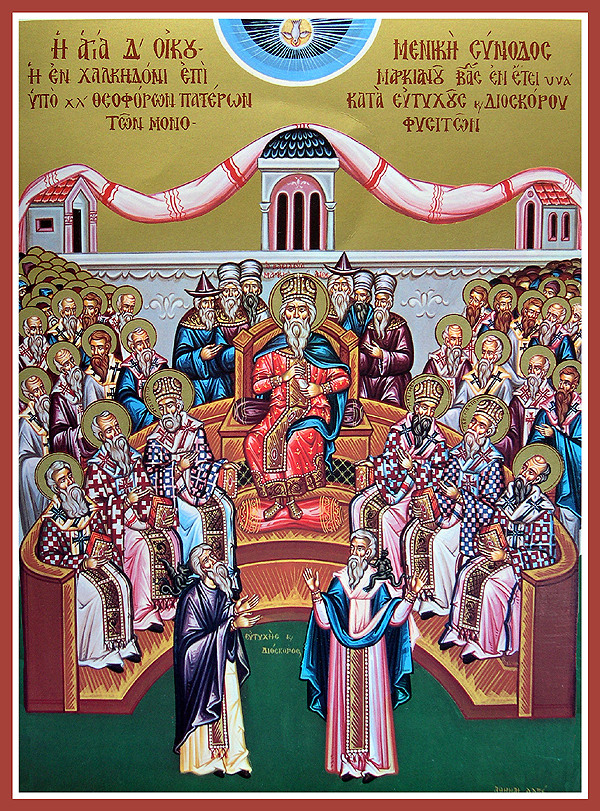
Commemoration of the Holy Fathers of the First Six Ecumenical Councils
|
| |
Fathers of the First Six Councils
Commemorated on July 14
(OCA) The Commemoration of the Holy Fathers of the First Six Ecumenical Councils.
In the Ninth Article of the Nicea-Constantinople Symbol of Faith proclaimed by the holy Fathers of the First and Second Ecumenical Councils, we confess our faith in “One, Holy, Catholic, and Apostolic Church.” By virtue of the catholic nature of the Church, an Ecumenical Council is the Church’s supreme authority, and possesses the competence to resolve major questions of church life. An Ecumenical Council is comprised of archpastors and pastors of the Church, and representatives of all the local Churches, from every land of the “oikumene” (i.e. from all the whole inhabited world).
The Orthodox Church acknowledges Seven Holy Ecumenical Councils:
- The First Ecumenical Council (Nicea I) (May 29, and also on seventh Sunday after Pascha) was convened in the year 325 against the heresy of Arius, in the city of Nicea in Bithynia under Saint Constantine the Great, Equal of the Apostles.
- The Second Ecumenical Council (Constantinople I) (May 22) was convened in the year 381 against the heresy of Macedonias, by the emperor Theodosius the Great.
- The Third Ecumenical Council (Ephesus) (September 9) was convened in the year 431 against the heresy of Nestorius, in the city of Ephesus by the emperor Theodosius the Younger.
- The Fourth Ecumenical Council (Chalcedon) (July 16) was convened in the year 451, against the Monophysite heresy, in the city of Chalcedon under the emperor Marcian.
- The Fifth Ecumenical Council (Constnatinople II) (July 25) “Concerning the Three Chapters,” was convened in the year 553, under the emperor Justinian the Great.
- The Sixth Ecumenical Council (Constantinople III) (January 23) met during the years 680-681, to fight the Monothelite heresy, under the emperor Constantine Pogonatos.
- The fact that the Seventh Ecumenical Council (Nicea II) is not commemorated today testifies to the antiquity of today’s celebration. The Seventh Council, commemorated on the Sunday nearest to October 11, was convened at Nicea in the year 787 against the Iconoclast heresy, under the emperor Constantine and his mother Irene.
The Church venerates the Holy Fathers of the Ecumenical Councils because Christ has established them as “lights upon the earth,” guiding us to the true Faith. “Clad in the garment of truth,” the doctrine of the Fathers, based upon the preaching of the Apostles, has established one faith for the Church. The Ecumenical Councils, are the highest authority in the Church. Such Councils, guided by the grace of the Holy Spirit, and accepted by the Church, are infallible.
The Orthodox Church’s conciliar definitions of dogma have the highest authority, and such definitions always begin with the Apostolic formula: “It seemed good to the Holy Spirit and to us...” (Acts 15: 28).
The Ecumenical Councils were always convened for a specific reason: to combat false opinions and heresies, and to clarify the Orthodox Church’s teaching. But the Holy Spirit has thus seen fit, that the dogmas, the truths of faith, immutable in their content and scope, constantly and consequently are revealed by the conciliar mind of the Church, and are given precision by the holy Fathers within theological concepts and terms in exactly such measure as is needed by the Church itself for its economy of salvation. The Church, in expounding its dogmas, is dealing with the concerns of a given historical moment, “not revealing everything in haste and thoughtlessly, nor indeed, ultimately hiding something” (Saint Gregory the Theologian).
A brief summary of the dogmatic theology of the First Six Ecumenical Councils is formulated and contained in the First Canon of the Council of Trullo (also known as Quinisext), held in the year 692. The 318 Holy Fathers of the First Ecumenical Council are spoken of in this Canon I of Trullo as having: “with unanimity of faith revealed and declared to us the consubstantiality of the three Persons of the Divine nature and, ... instructing the faithful to adore the Father, Son, and Holy Spirit with one worship, they cast down and dispelled the false teaching about different degrees of Divinity.”
The 150 Holy Fathers of the Second Ecumenical Council left their mark on the theology of the Church concerning the Holy Spirit, “repudiating the teaching of Macedonius, as one who wished to divide the inseparable Unity, so that there might be no perfect mystery of our hope.”
The 200 God-bearing Fathers of the Third Ecumenical Council expounded the teaching that “Christ, the Incarnate Son of God is One.” They also confessed that “she who bore Him without seed was the spotless Ever-Virgin, glorifying her as truly the Mother of God.
The 630 Holy Fathers of the Fourth Ecumenical Council decreed that “the One Christ, the Son of God... must be glorified in two natures.”
The 165 God-bearing Holy Fathers of the Fifth Ecumenical Council “in synod anathematized and repudiated Theodore of Mopsuestia (the teacher of Nestorius), and Origen, and Didymus, and Evagrius, renovators of the Hellenic teaching about the transmigration of souls and the transmutation of bodies and the impieties they raised against the resurrection of the dead.”
The 170 Holy Fathers of the Sixth Ecumenical Council “taught that we ought to confess two natural volitions, or two wills [trans. note: one divine, and the other human], and two natural operations (energies) in Him Who was incarnate for our salvation, Jesus Christ, our true God.”
In decisive moments of Church history, the holy Ecumenical Councils promulgated their dogmatic definitions, as trustworthy delimitations in the spiritual battle for the purity of Orthodoxy, which will last until such time, as “all shall come into the unity of faith, and of the knowledge of the Son of God” (Eph. 4: 13). In the struggle with new heresies, the Church does not abandon its former dogmatic concepts nor replace them with some sort of new formulations. The dogmatic formulae of the Holy Ecumenical Councils need never be superseded, they remain always contemporary to the living Tradition of the Church. Therefore the Church proclaims:
“The faith of all in the Church of God hath been glorified by men, which were luminaries in the world, cleaving to the Word of Life, so that it be observed firmly, and that it dwell unshakably until the end of the ages, conjointly with their God-bestown writings and dogmas. We reject and we anathematize all whom they have rejected and anathematized, as being enemies of Truth. And if anyone does not cleave to nor admit the aforementioned pious dogmas, and does not teach or preach accordingly, let him be anathema” (Canon I of the Council of Trullo).
In addition to their dogmatic definitions, the Holy Fathers of the Ecumenical Councils exerted great efforts towards the strengthening of church discipline. Local Councils promulgated their disciplinary canons according to the circumstances of the time and place, frequently differing among themselves in various particulars.
The universal unity of the Orthodox Church required unity also in canonical practice, i.e. a conciliar deliberation and affirmation of the most important canonical norms by the Fathers of the Ecumenical Councils. Thus, according to conciliar judgment, the Church has accepted: 20 Canons from the First, 7 Canons from the Second, 8 Canons from the Third, and 30 Canons from the Fourth Ecumenical Synods. The Fifth and the Sixth Councils concerned themselves only with resolving dogmatic questions, and did not leave behind any disciplinary canons.
The need to establish in codified form the customary practices during the years 451-680, and ultimately to compile a canonical codex for the Orthodox Church, occasioned the convening of a special Council, which was wholly devoted to the general application of churchly rules. This was convened in the year 692. The Council “in the Imperial Palace” or “Under the Arches” (in Greek “en trullo”), came to be called the Council in Trullo. It is also called the “Quinisext” [meaning the “fifth and sixth”], because it is considered to have completed the activities of the Fifth and Sixth Councils, or rather that it was simply a direct continuation of the Sixth Ecumenical Council itself, separated by just a few years.
The Council in Trullo, with its 102 Canons (more than of all the Ecumenical Synods combined), had a tremendous significance in the history of the canonical theology of the Orthodox Church. It might be said that the Fathers of this Council produced a complete compilation of the basic codex from the relevant sources for the Orthodox Church’s canons. Listing through in chronological order, and having been accepted by the Church the Canons of the Holy Apostles, and the Canons of the Holy Ecumenical and the Local Councils and of the holy Fathers, the Trullo Council declared: “Let no one be permitted to alter or to annul the aforementioned canons, nor in place of these put forth, or to accept others, made of spurious inscription” (2nd Canon of the Council in Trullo).
Church canons, sanctified by the authority of the first Six Ecumenical Councils (including the rules of the Seventh Ecumenical Council in 787, and the Constantinople Councils of 861 and 879, which were added later under the holy Patriarch Photius), form the basis of THE RUDDER, or KORMCHAYA KNIGA (a canon law codex known as “Syntagma” or “Nomokanon” in 14 titles). In its repository of grace is expressed a canonical norm, a connection to every era, and a guide for all the local Orthodox Churches in churchly practice.
New historical conditions can lead to the change of some particular external aspect of the life of the Church. This makes creative canonical activity necessary in the conciliar reasoning of the Church, in order to reconcile the external norms of churchly life with historical circumstances. The details of canonical regulation are not fully developed for the various eras of churchly organization all at once. With every push to either forsake the literal meaning of a canon, or to fulfill and develop it, the Church again and again turns for reasoning and guidance to the eternal legacy of the Holy Ecumenical Councils, to the inexhaustable treasury of dogmatic and canonical truths. |
| |
|
Glory to Jesus Christ!
We will celebrate the Akathist to our Lady, Queen of All at noon, on Thursday, July 11. If there are people you would like remembered, please submit their names here.
In Christ,
Fr Gregory |
| |
This Week at Ss Cyril & Methodius
Wednesday, July 10
- 11:00 AM- 3:00 PM: Office Hours/Confessions
Thursday, July 11
- 11:00 AM- 3:00 PM: Office Hours/Confessions
- Noon: Akathist to Our Lady, Queen of All
Saturday, July 13
- 3:30 PM: Catechumen/Inquirers Class
- 5:00 PM: Great Vespers
- 6:00 PM: Confessions
Sunday, July 14
- 9:00 AM: Hours
- 9:30 AM: Divine Liturgy
|
| |
Looking Ahead to Next Week
Wednesday, July 17
- 11:00 AM- 3:00 PM: Office Hours/Confessions
Thursday, July 18
- 11:00 AM- 3:00 PM: Office Hours/Confessions
Saturday, July 20
- 3:30 PM: Catechumen/Inquirers Class
- 5:00 PM: Great Vespers
- 6:00 PM: Confessions
Sunday, July 21
- 9:00 AM: Hours
- 9:30 AM: Divine Liturgy followed by blessing of vehicles
|
| |
Hymns After the Small Entrance
Tone 2 Troparion (Resurrection)
When Thou didst descend to death, O Life immortal, Thou didst slay hell with the splendor of Thy Godhead. And when from the depths Thou didst raise the dead, all the powers of heaven cried out://“O Giver of life, Christ our God, glory to Thee!”
Tone 8 Troparion (Fathers)
Thou art most glorious, O Christ our God, Who hast established the Holy Fathers as lights on the earth. Through them Thou hast guided us to the True Faith.//O greatly compassionate One, glory to Thee!
Tone 2 Kontakion (Resurrection)
Hell became afraid, O almighty Savior, seeing the miracle of Thy Resurrection from the tomb! The dead arose! Creation, with Adam, beheld this and rejoiced with Thee,// and the world, my Savior, praises Thee forever.
Glory to the Father, and to the Son, and to the Holy Spirit,
Tone 8 Kontakion (Fathers)
The Apostles’ preaching and the Fathers’ doctrines have established one Faith for the Church. Adorned with the robe of truth, woven from heavenly theology,//It defines and glorifies the great mystery of piety.
now and ever, and unto ages of ages. Amen.
Tone 6 Theotokion
O protection of Christians that cannot be put to shame, / O mediation unto the Creator unfailing, / disdain not the suppliant voices of sinners, / but be thou quick, O good one, to help us who in faith cry unto thee; / hasten to intercession and speed thou to make supplication, // thou who dost ever protect, O Theotokos, them that honour thee.
|
| |
|
Epistle: Romans 5:1-10//Hebrews 13: 7-16
Brethren, Therefore, having been justified by faith, we have peace with God through our Lord Jesus Christ, through whom also we have access by faith into this grace in which we stand, and rejoice in hope of the glory of God. And not only that, but we also glory in tribulations, knowing that tribulation produces perseverance; and perseverance, character; and character, hope. Now hope does not disappoint, because the love of God has been poured out in our hearts by the Holy Spirit who was given to us.
For when we were still without strength, in due time Christ died for the ungodly. For scarcely for a righteous man will one die; yet perhaps for a good man someone would even dare to die. But God demonstrates His own love toward us, in that while we were still sinners, Christ died for us. Much more then, having now been justified by His blood, we shall be saved from wrath through Him. For if when we were enemies we were reconciled to God through the death of His Son, much more, having been reconciled, we shall be saved by His life.
Remember those who rule over you, who have spoken the word of God to you, whose faith follow, considering the outcome of their conduct. Jesus Christ is the same yesterday, today, and forever. Do not be carried about with various and strange doctrines. For it is good that the heart be established by grace, not with foods which have not profited those who have been occupied with them.
We have an altar from which those who serve the tabernacle have no right to eat. For the bodies of those animals, whose blood is brought into the sanctuary by the high priest for sin, are burned outside the camp. Therefore Jesus also, that He might sanctify the people with His own blood, suffered outside the gate. Therefore let us go forth to Him, outside the camp, bearing His reproach. For here we have no continuing city, but we seek the one to come. Therefore by Him let us continually offer the sacrifice of praise to God, that is, the fruit of our lips, giving thanks to His name. But do not forget to do good and to share, for with such sacrifices God is well pleased.
Gospel: Matthew 6:22-33//John 17:1-13
“The lamp of the body is the eye. If therefore your eye is good, your whole body will be full of light. But if your eye is bad, your whole body will be full of darkness. If therefore the light that is in you is darkness, how great is that darkness!
“No one can serve two masters; for either he will hate the one and love the other, or else he will be loyal to the one and despise the other. You cannot serve God and mammon.
“Therefore I say to you, do not worry about your life, what you will eat or what you will drink; nor about your body, what you will put on. Is not life more than food and the body more than clothing? Look at the birds of the air, for they neither sow nor reap nor gather into barns; yet your heavenly Father feeds them. Are you not of more value than they? Which of you by worrying can add one cubit to his stature?
“So why do you worry about clothing? Consider the lilies of the field, how they grow: they neither toil nor spin; and yet I say to you that even Solomon in all his glory was not arrayed like one of these. Now if God so clothes the grass of the field, which today is, and tomorrow is thrown into the oven, will He not much more clothe you, O you of little faith?
“Therefore do not worry, saying, ‘What shall we eat?’ or ‘What shall we drink?’ or ‘What shall we wear?’ For after all these things the Gentiles seek. For your heavenly Father knows that you need all these things. But seek first the kingdom of God and His righteousness, and all these things shall be added to you.
Jesus spoke these words, lifted up His eyes to heaven, and said: “Father, the hour has come. Glorify Your Son, that Your Son also may glorify You, as You have given Him authority over all flesh, that He should give eternal life to as many as You have given Him. And this is eternal life, that they may know You, the only true God, and Jesus Christ whom You have sent. I have glorified You on the earth. I have finished the work which You have given Me to do. And now, O Father, glorify Me together with Yourself, with the glory which I had with You before the world was.
“I have manifested Your name to the men whom You have given Me out of the world. They were Yours, You gave them to Me, and they have kept Your word. Now they have known that all things which You have given Me are from You. For I have given to them the words which You have given Me; and they have received them, and have known surely that I came forth from You; and they have believed that You sent Me.
“I pray for them. I do not pray for the world but for those whom You have given Me, for they are Yours. And all Mine are Yours, and Yours are Mine, and I am glorified in them. Now I am no longer in the world, but these are in the world, and I come to You. Holy Father, keep through Your name those whom You have given Me, that they may be one as We are. While I was with them in the world, I kept them in Your name. Those whom You gave Me I have kept; and none of them is lost except the son of perdition, that the Scripture might be fulfilled. But now I come to You, and these things I speak in the world, that they may have My joy fulfilled in themselves. |
| |
|
By the age of 25, about 60% of those baptized as infants will no longer consider themselves members of the Orthodox Church. A parish on a university campus is an important witness not only to the surrounding community but also to high school age and younger parishioner. Establishing a parish on the campus of the University of Wisconsin-Madison helps remind young people that graduating high school doesn't mean "graduating" from the Church. Please consider joining those who have committed their time, treasure and talent in establishing an Orthodox community on the Isthmus.
Please help us reach your children and grandchildren with the Gospel of Jesus Christ by clicking the gofundme link. |
| |
|