Click above to send names of those to be commemorated at Liturgy.
Sunday, May 12, 2024
Antipascha; 2nd Sunday of Pascha
St. Thomas Sunday
Sunday of St Thomas
Commemorated on May 12
Introduction
(GOARCH) The Orthodox Church observes the Sunday of Thomas one week following the celebration of the Sunday of Holy Pascha. The day commemorates the appearance of Christ to His disciples on the evening of the Sunday following Passover. It also commemorates the appearance of the Lord to His disciples eight days later when Thomas was present and proclaimed "My Lord and my God" upon seeing the hands and side of Christ.
This Sunday is also called Antipascha (meaning "in the stead of Pascha," not "in opposition to Pascha") because with this day, the first Sunday after Pascha, the Church consecrates every Sunday of the year to the commemoration of Pascha, that is, the Resurrection.
Saint Thomas the Apostle is commemorated by the Church on October 6.
Biblical Story
The events commemorated on the Sunday of Thomas are recorded in the Gospel of Saint John 20:19-29. Following the crucifixion and burial of Christ, the disciples were gathered in a room with the doors closed and locked for fear of the Jews. On the evening of the Sunday after Passover, Jesus Christ entered the room and stood in their midst, greeting them with the words, "Peace be with you." (v. 19) He showed the disciples his hands, feet, and side. (v. 20)
Thomas was not present with the disciples when Jesus appeared, and he did not accept the testimony of the other disciples concerning Christ's Resurrection. He stated, "Unless I see the mark of the nails in his hands and put my finger in the mark of the nails and my hand in his side, I will not believe." (vv. 24-25)
Eight days later, the disciples were gathered together again with Thomas present, and the Lord appeared in the same manner. Standing in their midst he said, "Peace be with you." He then spoke directly to Thomas and said, "Put your finger here and see my hands. Reach out your hand and put it in my side. Do not doubt but believe." (vv. 26-27) Thomas answered, "My Lord and my God!" Jesus replied by saying, "Have you believed because you have seen me? Blessed are those who have not seen and yet have come to believe." (v. 29)
Icon of the Sunday of Thomas
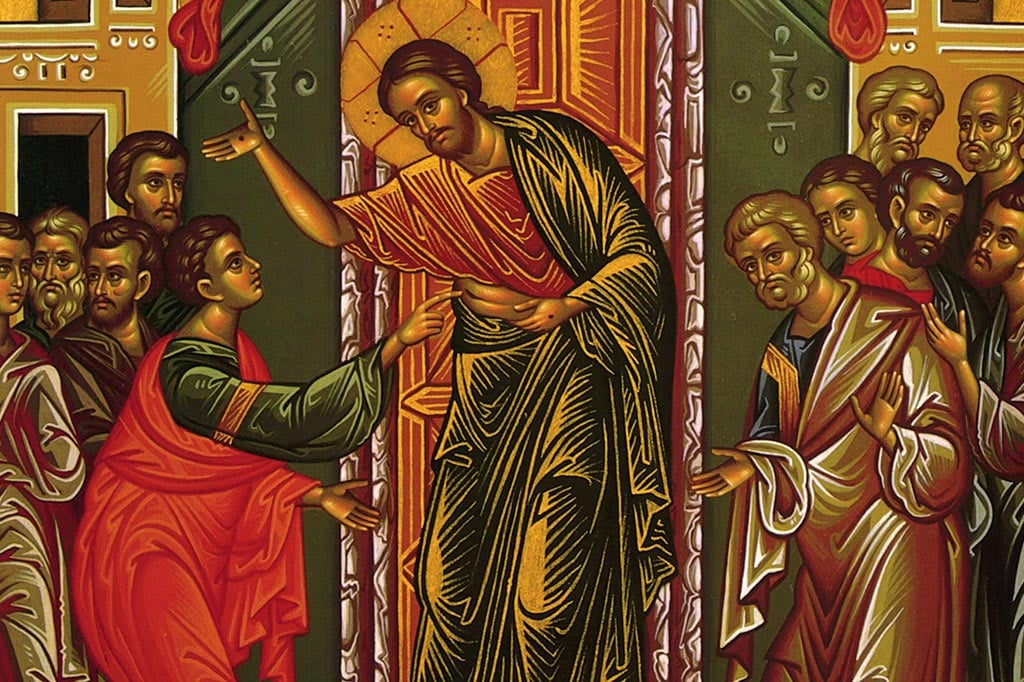
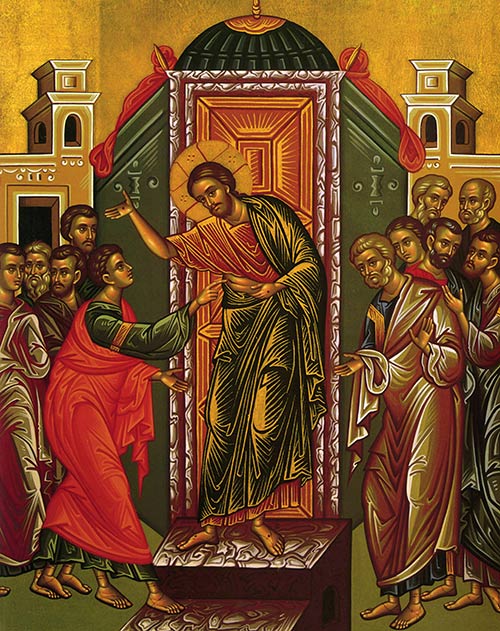
The icon of the Sunday of Thomas depicts Christ standing in the midst of the disciples. He has appeared to the eleven in the upper room, and he is inviting Thomas to come and examine his hands and his side. Thomas is reaching out to touch the side of Jesus. He is also looking to Jesus in a manner that indicates his faith and the proclamation recorded in Scripture.
Glory to Jesus Christ!
Congratulations to Joseph (Mitch) Aiken who was baptized on Lazarus Saturday.
Thank you everyone for making Holy Week and Pascha a success! Thank you especially to Katie and the choir for all their hard work in singing all the services.
Again, thanks to everyone for all your hard work!
In Christ,
Fr Gregory
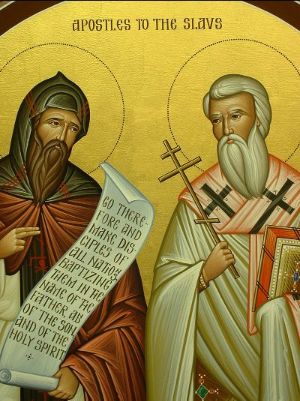
Equals of the Apostles and Teachers of the Slavs, Cyril and Methodius
Saints Cyril and Methodius, Equals of the Apostles, and Enlighteners of the Slavs came from an illustrious and pious family living in the Greek city of Thessalonica. Saint Methodius was the oldest of seven brothers, Saint Constantine [Cyril was his monastic name] was the youngest. At first Saint Methodius was in the military and was governor in one of the Slavic principalities dependent on the Byzantine Empire, probably Bulgaria, which made it possible for him to learn the Slavic language. After living there for about ten years, Saint Methodius later received monastic tonsure at one of the monasteries on Mount Olympus (Asia Minor).
Saint Constantine distinguished himself by his great aptitude, and he studied with the emperor Michael under the finest teachers in Constantinople, including Saint Photius, the future Patriarch of Constantinople (February 6).
Saint Constantine studied all the sciences of his time, and also knew several languages. He also studied the works of Saint Gregory the Theologian. Because of his keen mind and penetrating intellect, Saint Constantine was called “Philosopher” (wise). Upon the completion of his education, Saint Constantine was ordained to the holy priesthood and was appointed curator of the patriarchal library at the church of Hagia Sophia. He soon left the capital and went secretly to a monastery.
Discovered there, he returned to Constantinople, where he was appointed as instructor in philosophy. The young Constantine’s wisdom and faith were so great that he won a debate with Ananias, the leader of the heretical iconclasts. After this victory Constantine was sent by the emperor to discuss the Holy Trinity with the Saracens, and again he gained the victory. When he returned, Saint Constantine went to his brother Saint Methodius on Olympus, spending his time in unceasing prayer and reading the works of the holy Fathers.
The emperor soon summoned both of the holy brothers from the monastery and sent them to preach the Gospel to the Khazars. Along the way they stayed in the city of Korsun, making preparations for their missionary activity. There the holy brothers miraculously discovered the relics of the hieromartyr Clement, Pope of Rome (November 25).
There in Korsun Saint Constantine found a Gospel and Psalter written in Russian letters [i.e. Slavonic], and a man speaking the Slavic tongue, and he learned from this man how to read and speak this language. After this, the holy brothers went to the Khazars, where they won a debate with Jews and Moslems by preaching the Gospel. On the way home, the brothers again visited Korsun and, taking up the relics of Saint Clement, they returned to Constantinople. Saint Constantine remained in the capital, but Saint Methodius was made igumen of the small Polychronion monastery near Mount Olympus, where he lived a life of asceticism as before.
Soon messengers came to the emperor from the Moravian prince Rostislav, who was under pressure from German bishops, with a request to send teachers to Moravia who would be able to preach in the Slavic tongue. The emperor summoned Saint Constantine and said to him, “You must go there, but it would be better if no one knows about this.”
Saint Constantine prepared for the new task with fasting and prayer. With the help of his brother Saint Methodius and the disciples Gorazd, Clement, Savva, Naum and Angelyar, he devised a Slavonic alphabet and translated the books which were necessary for the celebration of the divine services: the Gospel, Epistles, Psalter, and collected services, into the Slavic tongue. This occurred in the year 863.
After completing the translation, the holy brothers went to Moravia, where they were received with great honor, and they began to teach the services in the Slavic language. This aroused the malice of the German bishops, who celebrated divine services in the Moravian churches in Latin. They rose up against the holy brothers, convinced that divine services must be done in one of three languages: Hebrew, Greek or Latin.
Saint Constantine said, “You only recognize three languages in which God may be glorified. But David sang, ‘Praise the Lord, all nations, praise the Lord all peoples (Ps 116/117:1).’ And the Gospel of Saint Matthew (28:18) says, ‘Go and teach all nations....’” The German bishops were humiliated, but they became bitter and complained to Rome.
The holy brothers were summoned to Rome for a decision on this matter. Taking with them the relics of Saint Clement, Saints Constantine and Methodius set off to Rome. Knowing that the holy brothers were bringing these relics with them, Pope Adrian met them along the way with his clergy. The holy brothers were greeted with honor, the Pope gave permission to have divine services in the Slavonic language, and he ordered the books translated by the brothers to be placed in the Latin churches, and to serve the Liturgy in the Slavonic language.
At Rome Saint Constantine fell ill, and the Lord revealed to him his approaching death. He was tonsured into the monastic schema with the name of Cyril. On February 14, 869, fifty days after receiving the schema, Saint Cyril died at the age of forty-two.
Saint Cyril commanded his brother Saint Methodius to continue with their task of enlightening the Slavic peoples with the light of the true Faith. Saint Methodius entreated the Pope to send the body of his brother for burial in their native land, but the Pope ordered the relics of Saint Cyril to be placed in the church of Saint Clement, where miracles began to occur from them.
After the death of Saint Cyril, the Pope sent Saint Methodius to Pannonia, after consecrating him as Archbishop of Moravia and Pannonia, on the ancient throne of Saint Andronicus (July 30). In Pannonia Saint Methodius and his disciples continued to distribute services books written in the Slavonic language. This again aroused the wrath of the German bishops. They arrested and tried Saint Methodius, who was sent in chains to Swabia, where he endured many sufferings for two and a half years.
After being set free by order of Pope John VIII of Rome, and restored to his archdiocese, Saint Methodius continued to preach the Gospel among the Slavs. He baptized the Czech prince Borivoi and his wife Ludmilla (September 16), and also one of the Polish princes. The German bishops began to persecute the saint for a third time, because he did not accept the erroneous teaching about the procession of the Holy Spirit from both the Father and the Son. Saint Methodius was summoned to Rome, but he justified himself before the Pope, and preserved the Orthodox teaching in its purity, and was sent again to the capital of Moravia, Velehrad.
Here in the remaining years of his life Saint Methodius, assisted by two of his former pupils, translated the entire Old Testament into Slavonic, except for the Book of Maccabbees, and even the Nomocanon (Rule of the Holy Fathers) and Paterikon (book of the Holy Fathers).
Sensing the nearness of death, Saint Methodius designated one of his students, Gorazd, as a worthy successor to himself. The holy bishop predicted the day of his death and died on April 6, 885 when he was about sixty years old. The saint’s burial service was chanted in three languages, Slavonic, Greek, and Latin. He was buried in the cathedral church of Velehrad.
This Week at Ss Cyril & Methodius
Wednesday, May 8
11:00 AM- 3:00 PM: Office Hours/Confessions
Thursday, May 9
2:00 PM- 5:00 PM: Office Hours/Confessions
6:00 PM: OCF Meeting
Saturday, May 11
3:00 PM: Catechumen/Inquirers Class
5:00 PM: Great Vespers
6:00 PM: Confessions
Sunday, May 12: Thomas Sunday
9:00 AM: Hours
9:30 AM: Divine Liturgy
Looking Ahead to Next Week
Wednesday, May 15
11:00 AM- 3:00 PM: Office Hours/Confessions
Thursday, May 16
2:00 PM- 5:00 PM: Office Hours/Confessions
Saturday, May 18
3:00 PM: Catechumen/Inquirers Class
5:00 PM: Great Vespers
6:00 PM: Confessions
Sunday, May 19: Myrhhbearing Women
9:00 AM: Hours
9:30 AM: Divine Liturgy
Priest: “Blessed is the Kingdom…”
Choir: “Amen.”
Priest: “Christ is risen… “ (2 ½ times)
Choir: “and upon those in the tombs bestowing life!”
(The Divine Liturgy is begun in this manner until the Leavetaking of Pascha.)
Hymns After the Small Entrance
Tone 7Troparion(Pentecostarion)
From the sealed tomb, Thou didst shine forth, O Life! Through closed doors Thou didst come to Thy Disciples, O Christ God. Renew in us through them an upright spirit,//by the greatness of Thy mercy, O Resurrection of all!
Glory to the Father, and to the Son, and to the Holy Spirit; now and ever, and unto ages of ages. Amen.
Tone 8Kontakion(Pentecostarion)
Thomas touched Thy life-giving side with an eager hand, O Christ God, when Thou camest to Thine Apostles through closed doors.//He cried out with all: “Thou art my Lord and my God!”
Epistle: Acts 5:12-20
In those days, through the hands of the apostles many signs and wonders were done among the people. And they were all with one accord in Solomon’s Porch. Yet none of the rest dared join them, but the people esteemed them highly. And believers were increasingly added to the Lord, multitudes of both men and women, so that they brought the sick out into the streets and laid them on beds and couches, that at least the shadow of Peter passing by might fall on some of them. Also a multitude gathered from the surrounding cities to Jerusalem, bringing sick people and those who were tormented by unclean spirits, and they were all healed.
Then the high priest rose up, and all those who were with him (which is the sect of the Sadducees), and they were filled with indignation, and laid their hands on the apostles and put them in the common prison. But at night an angel of the Lord opened the prison doors and brought them out, and said, “Go, stand in the temple and speak to the people all the words of this life.”
Gospel: John 20:19-31
Then, the same day at evening, being the first day of the week, when the doors were shut where the disciples were assembled, for fear of the Jews, Jesus came and stood in the midst, and said to them, “Peace be with you.” When He had said this, He showed them His hands and His side. Then the disciples were glad when they saw the Lord.
So Jesus said to them again, “Peace to you! As the Father has sent Me, I also send you.” And when He had said this, He breathed on them, and said to them, “Receive the Holy Spirit. If you forgive the sins of any, they are forgiven them; if you retain the sins of any, they are retained.”
Now Thomas, called the Twin, one of the twelve, was not with them when Jesus came. The other disciples therefore said to him, “We have seen the Lord.”
So he said to them, “Unless I see in His hands the print of the nails, and put my finger into the print of the nails, and put my hand into His side, I will not believe.”
And after eight days His disciples were again inside, and Thomas with them. Jesus came, the doors being shut, and stood in the midst, and said, “Peace to you!” Then He said to Thomas, “Reach your finger here, and look at My hands; and reach your hand here, and put it into My side. Do not be unbelieving, but believing.”
And Thomas answered and said to Him, “My Lord and my God!”
Jesus said to him, “Thomas, because you have seen Me, you have believed. Blessed are those who have not seen and yet have believed.”
And truly Jesus did many other signs in the presence of His disciples, which are not written in this book; but these are written that you may believe that Jesus is the Christ, the Son of God, and that believing you may have life in His name.
++++++++++++++++++++++++++
(Instead of “It is truly meet…,” we sing:)
The Angel cried to the Lady, full of grace:
“Rejoice, O pure Virgin! Again, I say: Rejoice,
thy Son is risen from His three days in the tomb!
With Himself He has raised all the dead.”
Rejoice, O ye people!
Shine, shine, O new Jerusalem!
The glory of the Lord has shone on thee.
Exult now, and be glad, O Zion!
Be radiant, O pure Theotokos,
in the Resurrection of thy Son!
Communion Hymn
Praise the Lord, O Jerusalem! Praise thy God, O Zion! (Ps. 147:1)
Alleluia, Alleluia, Alleluia!
++++++++++++++++++++++++++
Priest: “In the fear of God…”
Choir: “Blessed is He that comes in the Name of the Lord… “
Priest: “O God, save Thy people… “
Choir: “Christ is risen from the dead… “ (sung once, instead of “We have seen the True Light…)
Priest: “Always, now and ever…”
Choir: “Let our mouths be filled…”
At the Dismissal, the Priest says: “Glory to Thee, O Christ…” and the choir sings “Christ is risen from the dead…” (thrice).
And unto us He has given eternal life.
Let us worship His Resurrection on the third day!
By the age of 25, about 60% of those baptized as infants will no longer consider themselves members of the Orthodox Church. A parish on a university campus is an important witness not only to the surrounding community but also to high school age and younger parishioner. Establishing a parish on the campus of the University of Wisconsin-Madison helps remind young people that graduating high school doesn't mean "graduating" from the Church. Please consider joining those who have committed their time, treasure and talent in establishing an Orthodox community on the Isthmus.
Please help us reach your children and grandchildren with the Gospel of Jesus Christ by clicking the gofundme link.