|
1020 Regent St
(Lower Level)
Madison, WI 53715
|
| |
|
Click above to send names of those to be commemorated at Liturgy. |
| |
Sunday, April 14, 2024
Tone 4
Fourth Sunday of Great Lent; St. John Climacus
|
| |
Sunday of the Holy Cross
Commemorated on April 7
Introduction
(GOARCH) On the Fourth Sunday of Holy Lent the Orthodox Church commemorates our Righteous Father John Climacus. He is called Climacus due to his authorship of the great spiritual work The Ladder of Divine Ascent. His commemoration is designated by the Church on one of the Sundays of Lent as his life and writings affirm him as a supreme bearer and proponent of Christian asceticism. The ascetic example of this great Saint of the Church inspires us in our Lenten journey.
Life of the Saint
Saint John Climacus was probably born in the second half of the sixth century; but his country and origins are alike unknown because, from the beginning of his renunciation of the world, he took great care to live as a stranger upon earth. "Exile," he wrote, "is a separation from everything, in order that one may hold on totally to God." We only know that, from the age of sixteen, after having received a solid intellectual formation, he renounced all the pleasures of this vain life for love of God and went to Mount Sinai, to the foot of the holy mountain on which God had in former times revealed His glory to Moses, and consecrated himself to the Lord with a burning heart as a sweet-smelling sacrifice.
Setting aside, from the moment of his entry into the stadium, all self-trust and self-satisfaction through unfeigned humility, he submitted body and soul to an elder called Martyrios and set himself, free from all care, to climb that spiritual ladder (klimax) at the top of which God stands, and to "add fire each day to fire, fervour to fervour, zeal to zeal." He saw his shepherd as "the image of Christ" and, convinced that his elder was responsible for him before God, he had only one care: to reject his own will and "with all deliberateness to put aside the capacity to make [his] own judgement," so that no interval passed between Martyrios' commands, even those that appeared unjustified, and the obedience of his disciple. In spite of this perfect submission, Martyrios kept him as a novice for four years and only tonsured him when he was twenty, after having tested his humility. Strategios, one of the monks present at the tonsure predicted that the new monk would one day become one of the great lights of the world. When, later, Martyrios and his disciple paid a visit to John the Savaite, one of the most famous ascetics of the time, the latter, ignoring the elder, poured water over John's feet. After they had left, John the Savaite declared that he did not know the young monk but, under the inspiration of the Holy Spirit, he had washed the feet of the Abbot of Sinai. The same prophecy was confirmed by the great Anastasios the Sinaite (April 21), whom they also went to visit.
In spite of his youth, John showed the maturity of an elder and great discernment. Thus one day, when he had been sent into the world on a mission, and finding himself with lay-people, he had preferred to give in somewhat to vainglory by eating very little, rather than to gluttony; for, of these two evils, it was better to choose that which is less dangerous for beginners in monastic life.
 He thus passed nineteen years in the blessed freedom from the care that obedience gives, freed from all conflict by the prayer of his spiritual father and on "a safe voyage, a sleeper's journey," moved towards the harbor of impassibility. On the death of Martyrios, he resolved to continue his ascension in solitude, a type of life suitable for only a small number, who, made strong on the rock of humility, flee from others so as not to be even for a moment deprived of the "sweetness of God." He did not commit himself to this path, one so full of snares, on his own judgment, but on the recommendation of the holy elder George Arsilaites, who instructed him in the way of life proper to hesychasts. As his exercise ground, he chose a solitary place called Tholas, situated five miles from the main monastery, where other hermits lived, each not far from the others. He stayed there for forty years, consumed by an ever-increasing love of God, without thought for his own flesh, free of all contact with men, having unceasing prayer and vigilance as his only occupation, in order to "keep his incorporeal self shut up in the house of the body," as an angel clothed in a body. He thus passed nineteen years in the blessed freedom from the care that obedience gives, freed from all conflict by the prayer of his spiritual father and on "a safe voyage, a sleeper's journey," moved towards the harbor of impassibility. On the death of Martyrios, he resolved to continue his ascension in solitude, a type of life suitable for only a small number, who, made strong on the rock of humility, flee from others so as not to be even for a moment deprived of the "sweetness of God." He did not commit himself to this path, one so full of snares, on his own judgment, but on the recommendation of the holy elder George Arsilaites, who instructed him in the way of life proper to hesychasts. As his exercise ground, he chose a solitary place called Tholas, situated five miles from the main monastery, where other hermits lived, each not far from the others. He stayed there for forty years, consumed by an ever-increasing love of God, without thought for his own flesh, free of all contact with men, having unceasing prayer and vigilance as his only occupation, in order to "keep his incorporeal self shut up in the house of the body," as an angel clothed in a body.
He use to eat all that was compatible with his monastic profession, but in very small quantities, thus subduing the tyranny of the flesh while not providing a pretext for vainglory. By living in solitude and retreat, he put to death the mighty flame of greed, which, under the pretext of charity and hospitality, leads negligent monks to gluttony, the door to all passions, and to the love of money, "a worship of idols and the offspring of unbelief." He triumphed over sloth (acedia), that death of the soul which attacks hesychasts in particular, and laxity, by the remembrance of death. By meditating on eternal rewards, he undid the chain of sadness; he knew only a single sadness: that "affliction which leads to joy" and makes us run with ardor along the path of repentance, purifying the soul from all its impurities.
What still prevented him from arriving at impassibility (apatheia)? He had long since conquered anger by the sword of obedience. He had suffocated vainglory, that three-pointed thorn which forever harasses those who battle for holiness, and which entwines itself with every virtue like a leech, by solitude and even more by silence. As a reward for his labors, which he took care to season constantly with self-accusation, the Lord gave him the queen of virtues, holy and precious humility: "a grace in the soul, and with a name known only to those who have had experience of it, a gift from God."
As his cell was too near the others, he would often withdraw to a distant cave at the foot of the mountain, which he made an antechamber of heaven by his groans and the tears which fell effortlessly from his eyes like an abundant spring, transfiguring his body as with a "wedding garment." By this blessed affliction and these continual tears, he "did not cease to celebrate daily" and kept perpetual prayer in his heart, which had become like an inviolable fortress against the assaults of evil thoughts (logismoi). Sometimes he was ravished in spirit in the midst of the angelic choirs, not knowing if he was in the body or out of it, and then with great simplicity he asked God to teach him about the mysteries of theology. When he came out of the furnace of prayer, he sometimes felt purified as if by fire, and sometimes totally radiant with light.
As for sleep, he allowed himself just the measure necessary to keep his spirit vigilant in prayer and, before sleeping, he prayed at length, or wrote down on tablets the fruit of his meditations on the inspired Scriptures.
He took great care over many years to keep his virtues hidden from human eyes, but, when God judged that the time had come for him to transmit to others the light he had acquired for the edification of the Church, He led a young monk named Moses to John, who, thanks to the intervention of the other ascetics, succeeded in overcoming the resistance of the man of God, and was accepted as his disciple. One afternoon, when Moses had gone a long way away to find earth for their little garden, and had lain down under a large rock to rest, Abba John, in his cell, received the revelation that Moses was in danger, and he immediately seized the weapon of prayer. In the evening, when Moses returned, he told John that in his sleep he had, all of a sudden, heard the voice of his elder calling him, at the very moment when the rock began to break away from its moorings and threatened to crush him.
 Saint John's prayer also had the power to heal visible and invisible wounds. It was thus that he delivered a monk from the demon of lust, which had pushed him to the point of despair. On another occasion, he made rain fall. Yet it was above all in the gift of spiritual teaching that God manifested His grace in him. Basing his teaching on his personal experience, he generously instructed all those who came to him on the snares which lay in wait for monks in their battle passions and against the prince of this world. This spiritual teaching, however, attracted the jealousy of some who then spread around calumnies about him, accusing him of being a conceited chatterer. Although his conscience was clear, Abba John did not attempt to justify himself but, seeking rather to take away any pretext from those who sought one, he stopped teaching for a whole year, convinced that it was better to do some slight harm to his friends rather than to exacerbate the resentment of the wicked. All the inhabitants of the desert were edified at his silence and by this proof of humility, and it was only at the insistence of his repentant calumniators that he agreed to receive visitors again. Saint John's prayer also had the power to heal visible and invisible wounds. It was thus that he delivered a monk from the demon of lust, which had pushed him to the point of despair. On another occasion, he made rain fall. Yet it was above all in the gift of spiritual teaching that God manifested His grace in him. Basing his teaching on his personal experience, he generously instructed all those who came to him on the snares which lay in wait for monks in their battle passions and against the prince of this world. This spiritual teaching, however, attracted the jealousy of some who then spread around calumnies about him, accusing him of being a conceited chatterer. Although his conscience was clear, Abba John did not attempt to justify himself but, seeking rather to take away any pretext from those who sought one, he stopped teaching for a whole year, convinced that it was better to do some slight harm to his friends rather than to exacerbate the resentment of the wicked. All the inhabitants of the desert were edified at his silence and by this proof of humility, and it was only at the insistence of his repentant calumniators that he agreed to receive visitors again.
Filled with all the virtues of action and contemplation, and having arrived at the summit of the holy ladder through victory over all the passions of the old man, Saint John shone like a star on the Sinai peninsula and was held in awe by all the monks. He thought himself no less of a beginner for all that and, avid to find examples of evangelical conduct, undertook journeys to various Egyptian monasteries. He visited in particular a great coenobitic monastery in the region of Alexandria, a veritable earthly paradise which was governed by a shepherd gifted with infallible discernment. This brotherhood was united by such charity in the Lord, exempt from all familiarity and useless talk, that the monks had scarcely need of the warnings of the superior, for they mutually encouraged each other to a most divine vigilance. Of all their virtues, the most admirable, according to John, was the way they were especially careful never to "injure a brother's conscience" in the slightest. He was also very edified by a visit to a dependency of this monastery, called "The Prison," where monks who had gravely sinned lived in extreme ascesis and gave extraordinary proofs of repentance, straining by their labors to receive God's forgiveness. Far from appearing as hard and intolerable, this prison seemed rather to the Saint to be the model of monastic life: "A soul that has lost its one-time confidence and abandoned its hope of dispassion, that has broken the seal of chastity, that has squandered the treasury of divine graces, that has become a stranger to divine consolation, that has rejected the Lord's command ... and that is wounded and pierced by sorrow as it remembers all this, will not only take on the labors mentioned above with all eagerness, but will even decide devoutly to kill itself with penitential works. It will do so if there is in it only the tiniest spark of love or of fear of the Lord."
When the Saint had sojourned these forty years in the desert, he was charged by God, like a second Moses, to be at the head of this new Israel by becoming abbot of the monastery at the foot of the holy mountain (c. 650). It is recounted that, on the day of his enthronement, six hundred pilgrims were present, and when they were all seated for the meal, the great prophet Moses himself, dressed in a white tunic, could be seen coming and going, giving orders with authority to the cooks, the cellarers, the stewards and the other helpers.
Having penetrated into the mystical darkness of contemplation, this new Moses, having been initiated into the secrets of the spiritual Law, and coming back down the mountain impassible, his face transfigured by divine grace, was able to become for all the shepherd, the physician and the spiritual master. Carrying within him the Book written by God, he did not have need of other books to teach his monks the science of the sciences and the art of arts.
The Abbot of Raitho, who was also named John, having been informed of the wonderful manner of life of the monks of Sinai, wrote to Saint John, asking him to explain briefly but in an methodical way what those who had embraced the angelic life should do in order to be saved. He who did not know how to go against the wishes of another, thus engraved with the stylus of his own experience the Tablets of the Spiritual Law. He presented this treatise as a Ladder of thirty steps, that Jacob, "he who supplanted the passions" contemplated while he was lying on the bed of ascesis (Genesis 28:12). In his Orthodox Summa of the spiritual life, which has remained for centuries the outstanding guide to evangelical living, both for monks and for lay people, Saint John does not institute rules but, by practical recommendations, judiciously-chosen details and short pithy maxims and riddles often full of humor, he initiates the soul into spiritual combat and the discernment of thoughts. His "word" is brief, dense and tapered, and it penetrates like a sword to the depths of the soul, uncompromisingly cutting out all self-satisfaction, and tracing hypocritical ascesis and egoism to their roots. Like that of Saint Gregory (January 25) in the theological domain, this "word" is the Gospel put into practice, and it will lead most surely those who let themselves be impregnated by it through an assiduous reading to the gates of heaven, where Christ awaits us.
At the end of his life, the blessed John designated his brother George, who had embraced the hesychast life from the beginning of his renunciation, as his successor at the head of the monastery. When he was about to die, George said to him: "So, you are abandoning me and leaving! I prayed, however, that you would send me to the Lord first, for without you I cannot shepherd this brotherhood." But Saint John reassured him, and said: "Do not grieve and do not be afraid. If I find grace before God, I shall not let you complete even a year after me." And it was so: ten months after John's falling asleep, George departed in his turn to the Lord. |
| |
|
Glory to Jesus Christ!
We're quickly coming to the end of Great Lent. If you've not been to confession during the fast, please do so at the scheduled confession times or make an appointment with me. If at all possible, please don't wait until Holy Week.
This Thursday, at 5:30 PM, we will celebrate the Akathist to the Queen of All for all those in need of healing (submit names here).
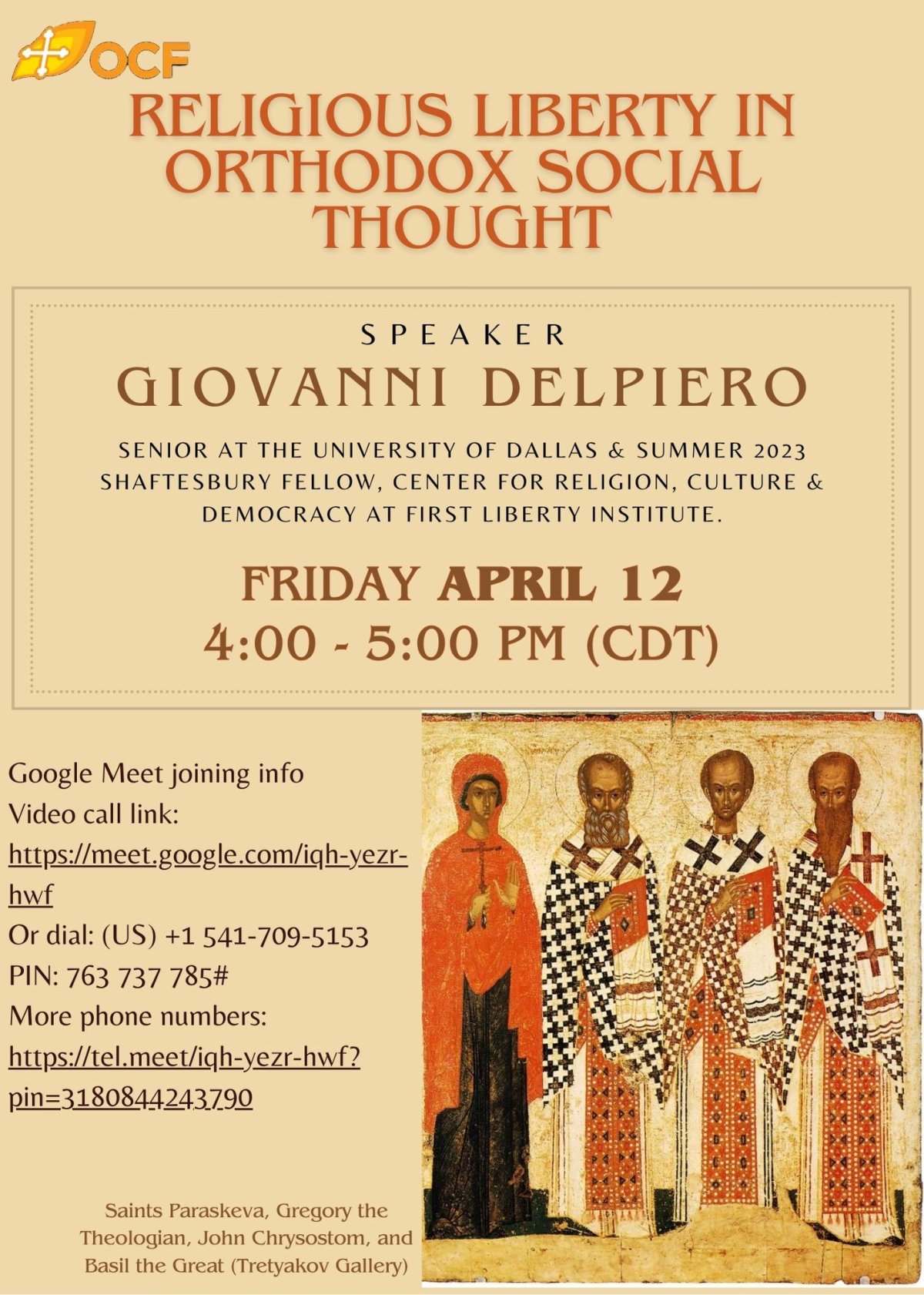
This Friday, I'm hosting a video presentation by Giovanni Delpiero, on religious liberty. Last summer, Gio was a Shaftesbury Fellow with the Center for Religion, Culture & Democracy and I was his mentor. There's a flier below announcing the presentation. Here's the information as well for those who are interested in listening in.
Religious Liberty in Orthodox Social Thought
Friday, April 12 · 4:00 – 5:00pm
Time zone: America/Chicago
Google Meet joining info
Video call link: https://meet.google.com/iqh-yezr-hwf
Or dial: (US) +1 541-709-5153 PIN: 763 737 785#
More phone numbers: https://tel.meet/iqh-yezr-hwf?pin=3180844243790
We shouldn't underestimate the role (for good and ill) of religion not only in domestic politics but also in conflicts around the world. Just recently, for example, the Moscow Patriarchate has called Russia's invasion of Ukraine a "Holy War" before going on to bless the forceful annexation of Ukraine and Belarus into a "greater Russia." As more than one commentator has observed, this means that the Russian Orthodox Church has now publicly supported genocide.
This and other current events highlight the timeliness of Gio's work not only for Orthodox Christians but also for Catholic and Protestant Christians, Jews, Muslims, and anyone wishing to understand the role of religion in current affairs.
In Christ,
Fr Gregory |
| |
This Week at Ss Cyril & Methodius
Wednesday, April 10
- 2:00 PM- 5:30 PM: Office Hours/Confessions
- 6:00 PM: Presanctified Liturgy
Thursday, April 11
- 2:00 PM- 5:00 PM: Office Hours/Confessions
- 5:30 PM: Akathist to the Queen of All (submit names here)
- 6:00 PM: OCF Meeting
Saturday, April 13
- 3:00 PM: Catechumen Class
- 4:00 PM: Choir Rehearsal
- 5:00 PM: Great Vespers
- 6:00 PM: Confessions
Sunday, April 14: Sunday of St. John Climacus
- 9:00 AM: Hours & Precommunion Prayers
- 9:30 AM: Divine Liturgy
|
| |
Looking Ahead
Wednesday, April 17
- 2:00 PM- 5:30 PM: Office Hours/Confessions
- 6:00 PM: Presanctified Liturgy
Thursday, April 18
- 2:00 PM- 5:00 PM: Office Hours/Confessions
- 6:00 PM: OCF Meeting
Saturday, April 20
- 3:00 PM: Catechumen Class
- 4:00 PM: Choir Rehearsal
- 5:00 PM: Great Vespers
- 6:00 PM: Confessions
Sunday, April 21: Sunday of St. Mary of Egypt
- 9:00 AM: Hours & Precommunion Prayers
- 9:30 AM: Divine Liturgy
|
| |
Hymns After the Small Entrance
Tone 4 Troparion (Resurrection)
When the women disciples of the Lord learned from the angel the joyous message of Thy Resurrection, they cast away the ancestral curse and elatedly told the apostles: “Death is overthrown! Christ God is risen,//granting the world great mercy!”
Tone 4 Troparion (Ss Cyril and Methodius)
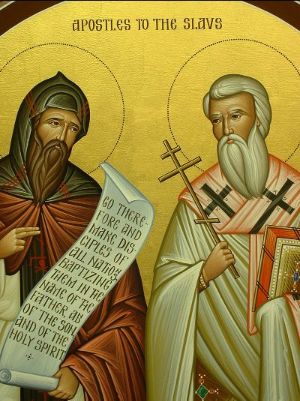
Divinely-wise Cyril and Methodius, / equals-to-the-apostles and teachers of the Slavs, / entreat the Master of all / to strengthen all nations in Orthodoxy and unity of mind, / to grant peace to the world and to save our souls.
Tone 1 Troparion (St. John Climacus)
O dweller of the wilderness and angel in the body, thou wast a wonderworker, O our God-bearing Father John. Thou didst receive heavenly gifts through fasting, vigil, and prayer, healing the sick and the souls of those drawn to thee by faith. Glory to Him Who gave thee strength! Glory to Him Who granted thee a crown!//Glory to Him Who grants healing to all!
Tone 4 Kontakion (Resurrection)
My Savior and Redeemer as God rose from the tomb and delivered the earth-born from their chains. He has shattered the gates of hell, and as Master,//He has risen on the third day!
Glory to the Father, and to the Son, and to the Holy Spirit,
Tone 4 Kontakion (St. John Climacus)
The Lord truly set thee on the heights of abstinence, to be a guiding star, showing the way to the universe,//O our father and teacher John.
now and ever, and unto ages of ages. Amen.
Tone 6 Theotokion
O protection of Christians that cannot be put to shame, mediation unto the Creator most constant, O despise not the suppliant voices of those who have sinned; but be thou quick, O good one, to come unto our aid, who in faith cry unto thee: Hasten to intercession, and speed thou to make supplication, thou who dost ever protect, O Theotokos, them that honor thee. |
| |
|
Epistle: Hebrews 6:13-20//Ephesians 5:9-19
Brethren, when God made a promise to Abraham, because He could swear by no one greater, He swore by Himself, saying, “Surely blessing I will bless you, and multiplying I will multiply you.” And so, after he had patiently endured, he obtained the promise. For men indeed swear by the greater, and an oath for confirmation is for them an end of all dispute. Thus God, determining to show more abundantly to the heirs of promise the immutability of His counsel, confirmed it by an oath, that by two immutable things, in which it is impossible for God to lie, we might have strong consolation, who have fled for refuge to lay hold of the hope set before us.
This hope we have as an anchor of the soul, both sure and steadfast, and which enters the Presence behind the veil, where the forerunner has entered for us, even Jesus, having become High Priest forever according to the order of Melchizedek.
Brethren, the fruit of the Spirit is in all goodness, righteousness, and truth, finding out what is acceptable to the Lord. And have no fellowship with the unfruitful works of darkness, but rather expose them. For it is shameful even to speak of those things which are done by them in secret. But all things that are exposed are made manifest by the light, for whatever makes manifest is light. Therefore He says:
“Awake, you who sleep,
Arise from the dead,
And Christ will give you light.”
See then that you walk circumspectly, not as fools but as wise, redeeming the time, because the days are evil.
Therefore do not be unwise, but understand what the will of the Lord is. And do not be drunk with wine, in which is dissipation; but be filled with the Spirit, speaking to one another in psalms and hymns and spiritual songs, singing and making melody in your heart to the Lord.
Gospel: Mark 9:17-31/Matthew 4:25-5:12
Then one of the crowd answered and said, “Teacher, I brought You my son, who has a mute spirit. And wherever it seizes him, it throws him down; he foams at the mouth, gnashes his teeth, and becomes rigid. So I spoke to Your disciples, that they should cast it out, but they could not.”
He answered him and said, “O faithless generation, how long shall I be with you? How long shall I bear with you? Bring him to Me.” Then they brought him to Him. And when he saw Him, immediately the spirit convulsed him, and he fell on the ground and wallowed, foaming at the mouth.
So He asked his father, “How long has this been happening to him?”
And he said, “From childhood. And often he has thrown him both into the fire and into the water to destroy him. But if You can do anything, have compassion on us and help us.”
Jesus said to him, “If you can believe, all things are possible to him who believes.”
Immediately the father of the child cried out and said with tears, “Lord, I believe; help my unbelief!”
When Jesus saw that the people came running together, He rebuked the unclean spirit, saying to it, “Deaf and dumb spirit, I command you, come out of him and enter him no more!” Then the spirit cried out, convulsed him greatly, and came out of him. And he became as one dead, so that many said, “He is dead.” But Jesus took him by the hand and lifted him up, and he arose.
And when He had come into the house, His disciples asked Him privately, “Why could we not cast it out?”
So He said to them, “This kind can come out by nothing but prayer and fasting.”
Then they departed from there and passed through Galilee, and He did not want anyone to know it. For He taught His disciples and said to them, “The Son of Man is being betrayed into the hands of men, and they will kill Him. And after He is killed, He will rise the third day.”
Great multitudes followed Him—from Galilee, and from Decapolis, Jerusalem, Judea, and beyond the Jordan.
And seeing the multitudes, He went up on a mountain, and when He was seated His disciples came to Him. Then He opened His mouth and taught them, saying:
“Blessed are the poor in spirit,
For theirs is the kingdom of heaven.
Blessed are those who mourn,
For they shall be comforted.
Blessed are the meek,
For they shall inherit the earth.
Blessed are those who hunger and thirst for righteousness,
For they shall be filled.
Blessed are the merciful,
For they shall obtain mercy.
Blessed are the pure in heart,
For they shall see God.
Blessed are the peacemakers,
For they shall be called sons of God.
Blessed are those who are persecuted for righteousness’ sake,
For theirs is the kingdom of heaven.
Blessed are you when they revile and persecute you, and say all kinds of evil against you falsely for My sake. Rejoice and be exceedingly glad, for great is your reward in heaven, for so they persecuted the prophets who were before you.
++++++++++++++++++++++
Hymn to the Theotokos
All of creation rejoices in thee, O Full of Grace:
the assembly of angels and the race of men.
O sanctified temple and spiritual paradise,
the glory of virgins,
from whom God was incarnate and became a Child:
our God before the ages.
He made thy body into a throne,
and thy womb He made more spacious than the heavens.
All of creation rejoices in thee, O Full of Grace.//
Glory to thee!
Communion Hymn
Praise the Lord from the heavens, praise Him in the highest!
Rejoice in the Lord, O you righteous; praise befits the just!
Alleluia, Alleluia, Alleluia! |
| |
|
By the age of 25, about 60% of those baptized as infants will no longer consider themselves members of the Orthodox Church. A parish on a university campus is an important witness not only to the surrounding community but also to high school age and younger parishioner. Establishing a parish on the campus of the University of Wisconsin-Madison helps remind young people that graduating high school doesn't mean "graduating" from the Church. Please consider joining those who have committed their time, treasure and talent in establishing an Orthodox community on the Isthmus.
Please help us reach your children and grandchildren with the Gospel of Jesus Christ by clicking the gofundme link. |
| |
|