|
1020 Regent St
(Lower Level)
Madison, WI 53715
|
| |
|
Click above to send names of those to be commemorated at Liturgy. |
| |
Sunday, March 31, 2024
Tone 2
Second Sunday of Great Lent; St. Gregory Palamas
|
| |
Sunday of St. Gregory Palamas
Commemorated on March 31
Introduction
(GOARCH) On the Second Sunday of Lent the Orthodox Church commemorates our Holy Father Gregory Palamas, Archbishop of Thessalonica, the Wonderworker. The feast day of Saint Gregory Palamas is November 14, however, he is commemorated on this Sunday as the condemnation of his enemies and the vindication of his teachings by the Church in the 14th century was acclaimed as a second triumph of Orthodoxy.
Life of the Saint
Our holy Father Gregory was born in Constantinople in 1296 of aristocratic parents who had emigrated from Asia Minor in the face of the Turkish invasion, and were attached to the court of the pious Emperor Andronicus II Palaeologus (1282-1328). Despite his official duties, Gregory's father led a life of fervent prayer. Sometimes as he sat in the Senate, he would be so deep in prayer as to be unaware of the Emperor addressing him. While Gregory was still young, his father died after being clothed in the monastic habit; and his mother for her part wanted to take the veil, but delayed doing so in order to take care of the education of her seven children. Gregory, the eldest, was instructed by the most highly reputed masters of secular learning and, after some years, was so proficient in philosophical reasoning that, on listening to him, his master could believe he was hearing Aristotle himself. Notwithstanding these intellectual successes, the young man's real interest lay only with the things of God. He associated with monks of renown in the city and found a spiritual father in Theoleptus of Philadelphia, who instructed him in the way of holy sobriety and of prayer of the heart.
About the year 1316, Gregory decided to abandon the vanities of the world. His mother, two sisters, two brothers and a great many of his servants entered upon the monastic life with him. He and his two brothers went on foot to the holy Mountain of Athos, where they settled near the Monastery of Vatopedi under the direction of the Elder Nicodemus, who came from Mount Auxentius. Gregory made rapid progress in the holy activity of prayer, for he had put into practice since childhood the fundamental virtues of obedience, humility, meekness, fasting, vigil and the different kinds of renunciation that make the body subject to the spirit. Night and day he besought God ceaselessly with tears saying, "Lighten my darkness!" After some time, the Mother of God, in whom he had put his trust since his youth, sent Saint John the Theologian to him with the promise of her protection in this life and in the next.
 After only three years, the early death of his brother Theodosius, followed by that of the Elder Nicodemus, led Gregory and his second brother, Macarius, to attach themselves to the Monastery of the Great Lavra. Gregory was appointed chanter. His conduct in the cenobitic life was beyond reproach, and the brethren admired his zeal for putting into practice all the holy evangelic virtues. He lived with such abstinence as to appear unburdened by the flesh to the extent of being able to go three months without sleep. At the end of three years of common life, his soul thirsting for the sweet waters of the wilderness, he retired to the hermitage of Glossia, under the direction of an eminent monk called Gregory of Byzantium. With the passions purified, he was now able to rise up in prayer to the contemplation of the mysteries of the Creation. Solitude and inner stillness enabled him to keep his intellect fixed at all times in the depths of his heart, where he called on the Lord Jesus with compunction, so that he became all prayer, and sweet tears flowed continually from his eyes as from two fountains. After only three years, the early death of his brother Theodosius, followed by that of the Elder Nicodemus, led Gregory and his second brother, Macarius, to attach themselves to the Monastery of the Great Lavra. Gregory was appointed chanter. His conduct in the cenobitic life was beyond reproach, and the brethren admired his zeal for putting into practice all the holy evangelic virtues. He lived with such abstinence as to appear unburdened by the flesh to the extent of being able to go three months without sleep. At the end of three years of common life, his soul thirsting for the sweet waters of the wilderness, he retired to the hermitage of Glossia, under the direction of an eminent monk called Gregory of Byzantium. With the passions purified, he was now able to rise up in prayer to the contemplation of the mysteries of the Creation. Solitude and inner stillness enabled him to keep his intellect fixed at all times in the depths of his heart, where he called on the Lord Jesus with compunction, so that he became all prayer, and sweet tears flowed continually from his eyes as from two fountains.
The incessant raids of Turkish pirates soon obliged Gregory and his companions to leave their hermitage. Together with twelve monks, he wanted to make the pilgrimage to the Holy Places and to seek refuge at Mount Sinai; but this did not prove feasible. Instead, he spent some time in Thessalonica, where he joined the group around the future Patriarch Isidore, who was endeavoring to spread the practice of the Jesus prayer among the faithful so that they might profit from the experience of the monks. In 1326, Gregory was ordained a priest, having understood in a vision that this was indeed the will of God. He then departed to found a hermitage in the area of Beroea, where he practiced an even stricter ascesis than before. For five days of the week he remained alone, fasting, keeping vigil and praying with abundant tears. He only appeared on Saturdays and Sundays to serve the Divine Liturgy, share a fraternal meal, and converse on some spiritual subject with his companions in the ascetic life. He continued thus to rise up in contemplation and to enter into closer union with God in his heart.
When his mother died, he went to Constantinople to fetch his sisters, whom he settled in a hermitage near his own. But as Serbian raids in the region became more and more frequent, he decided to go back to Mount Athos. He settled a little above the Lavra in the hermitage of Saint Savas, where he lived in greater seclusion than before, and could converse alone with God. He went to the monastery only infrequently and would receive his rare visitors on Sundays and feast days. Going on from that contemplation which is still outward, Gregory then attained to the vision of God in the light of the Holy Spirit and to the deification promised by Christ to His perfect disciples.
One day in a dream, he saw that he was full of a milk from heaven which, as it overflowed, changed into wine and filled the surrounding air with a wonderful scent. This was a sign to him that the moment had come to teach his brethren the mysteries that God revealed to him. He wrote several ascetic treatises at this time, and, in 1335, was appointed Abbot of the Monastery of Esphigmenou. But the two hundred monks who lived there understood neither his zeal nor his spiritual expectations so, after a year, he returned to his hermitage.
At that time, Barlaam, a monk from Calabria, won a great name for himself as a speculative thinker in Constantinople. He was particularly fond of expounding the mystical writings of Saint Dionysius the Areopagite, which he interpreted in an entirely philosophical way, making knowledge of God the object of cold reason and not of experience. When this refined humanist learned of the methods of prayer of some simple monks of his acquaintance, who allowed a place to the sensory element in spiritual life, he was scandalized. He took occasion to calumniate then and to accuse them of heresy. The hesychast monks appealed to Gregory who then wrote several polemical treatises in which he answered the accusations of Barlaam by locating monastic spirituality in a dogmatic synthesis.
He showed that ascesis and prayer are the outcome of the whole mystery of Redemption, and are the way for each person to make the grace given at Baptism blossom within himself. He also defended the authenticity of the methods which the Hesychasts used to fix the intellect in the heart; for since the Incarnation we have to seek the grace of the Holy Spirit in our bodies, which are sanctified by the Sacraments and grafted by the Eucharist into the Body of Christ. This uncreated grace is the very glory of God which, as it sprang forth from the body of Christ on the day of the Transfiguration, overwhelmed the disciples (Matthew 17). Shining now in the heart purified from the passions, it truly unites us to God, illumines us, deifies us and gives us a pledge of that same glory which will shine on the bodies of the Saints after the general Resurrection. In thus affirming the full reality of deification, Gregory was far from denying the absolute transcendence and unknowableness of God in His essence. Following the ancient Fathers, but in a more precise manner, he made a distinction between God's imparticipable essence and the eternal, creative and providential energies by which the Lord enables created beings to participate in His being, His life and His light without, however, introducing any division into the unity of the divine Nature. God is not a philosophical concept for Saint Gregory: He is Love, He is Living Person and consuming fire, as Scripture teaches (Deuteronomy 4:24), Who does everything to make us godlike.
Saint Gregory's brilliant answer to Barlaam was first accepted by the authorities of Mount Athos in the Hagiorite Tome and then adopted by the Church, which condemned Barlaam (and with him the philosophical humanism that would soon inspire the European Renaissance), during the course of two Councils at the Church of Saint Sophia in 1341.
Barlaam's condemnation and his departure for Italy did not bring the controversy to an end. No sooner had Gregory returned to his Athonite hermitage from Thessalonica where he had been writing his treatises in seclusion than Akindynos, an old friend of his, restated the substance of Barlaam's arguments and condemned Gregory's distinction between essence and energies as an innovation. Akindynos, who at first aspired to be an umpire between Barlaam and Gregory, was the kind of rigid conservative who does no more than repeat set phrases without seeking to enter into the spirit of the tradition. At the same time, a dreadful civil war broke out as a result of the rivalry between the Duke Alexis Apokaukos and Saint Gregory's friend, John Cantacuzenus (1341-47). The Patriarch, John Calecas, sided with Apokaukos and encouraged Akindynos to bring a charge of heresy against Gregory, which led to the excommunication and imprisonment of the Saint.
During the four years of Gregory's confinement, there was no slackening of his activity. He carried on a huge correspondence, and wrote an important work against Akindynos. When John Cantacuzenus gained the upper hand in 1346, the Regent, Ann of Savoy, came to the defense of the Saint and deposed the Patriarch on the eve of Cantacuzenus' triumphal entry into the City. He nominated Isidore as Patriarch (1347-50), and summoned a new Council to vindicate the Hesychasts. The controversy was not finally resolved until 1351, at a third Council which condemned the humanist Nicephorus Gregoras. In the Synodal Tome the doctrine of Saint Gregory on the uncreated energies and on the nature of grace was recognized as the rule of faith of the Orthodox Church.
Among Isidore's new episcopal appointments, Gregory was named Archbishop of Thessalonica in 1347; but he was unable to take possession of his see as the city was in the hands of the Zealots, the party opposed to Cantacuzenus. After finding shelter for a while in Lemnos, where he showed heroic devotion during an epidemic, Gregory was eventually able to enter the city acclaimed as if Christ Himself were coming in triumph, with the chanting of Paschal hymns.
During a voyage to Constantinople, he fell into the hands of some Turks, who held him for a year in Asia Minor (1354-55), but allowed him a measure of freedom. This, and his openness of spirit, enabled him to engage in amicable theological discussions with the Muslim doctors of religion and with the son of the Emir Orkhan. When he was set free, thanks to a ransom from Serbia, he returned to Thessalonica to take up his activity again as pastor and wonderworker. He suffered a long illness and, some time before his death, Saint John Chrysostom appeared to him with the invitation to join the choir of holy hierarchs immediately after his own feast. And, indeed, on November 14, 1359 the Saint gave up his soul to God. When he died, his countenance was radiant with a light like to that which shone on Saint Stephen (Acts 6:15). In this way God showed, through the person of his servant, the truth of his doctrine on the reality of deification by the uncreated light of the Holy Spirit. The veneration of Saint Gregory was approved by the Church in 1368. The Saint works many miracles even to the present day and, after Saint Demetrios, is regarded as the Protector of Thessalonica. |
| |
|
Glory to Jesus Christ!
I'll be out of town March 29-April 1 leading a retreat for the OCF and the parishioners of St. Nicholas Ukrainian Orthodox Church, Greenwood, VA. In case of emergency, please contact Fr Christopher.
This coming Sunday, March 31 at 4:00 PM, is the second of the pan-Orthodox Vespers at Assumption Greek Orthodox Church. Please plan to attend if you can.
In Christ,
Fr Gregory |
| |
This Week at Ss Cyril & Methodius
Wednesday, March 27
- 2:00 PM- 5:30 PM: Office Hours/Confessions
- 6:00 PM: Presanctified Liturgy
Thursday, March 28
- 2:00 PM- 5:00 PM: Office Hours/Confessions [canceled]
Friday, March 29-April 1: Fr Gregory of town
Saturday, March 30
- 3:00 PM: Catechumen Class [canceled]
- 4:00 PM: Choir Rehearsal
- 5:00 PM: Great Vespers
- 6:00 PM: Confessions
Sunday, March 31: Sunday of St Gregory Palamas
- 9:00 AM: Hours & Precommunion Prayers
- 9:30 AM: Divine Liturgy
- 4:00 PM: Pan-Orthodox Vespers and Reception (Assumption)
|
| |
Looking Ahead
Wednesday, April 3
- 2:00 PM- 5:30 PM: Office Hours/Confessions
- 6:00 PM: Presanctified Liturgy
Thursday, April 4
- 2:00 PM- 5:00 PM: Office Hours/Confessions
Saturday, April 6
- 3:00 PM: Catechumen Class
- 4:00 PM: Choir Rehearsal
- 5:00 PM: Great Vespers & Veneration of the Cross
- 6:00 PM: Confessions
Sunday, April 7: Sunday of the Holy Cross
- 9:00 AM: Hours & Precommunion Prayers
- 9:30 AM: Divine Liturgy
- 4:00 PM: Pan-Orthodox Vespers and Reception (St Ignatius)
|
| |
Hymns After the Small Entrance
Tone 2 Troparion (Resurrection)
When Thou didst descend to death, O Life immortal, Thou didst slay hell with the splendor of Thy Godhead. And when from the depths Thou didst raise the dead, all the powers of heaven cried out://“O Giver of life, Christ our God, glory to Thee!”
Tone 4 Troparion (Ss Cyril and Methodius)
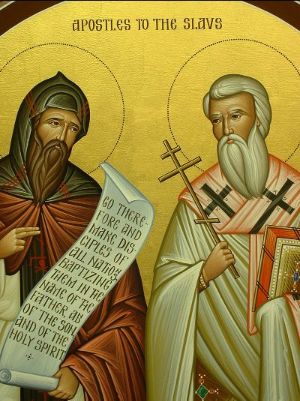
Divinely-wise Cyril and Methodius, / equals-to-the-apostles and teachers of the Slavs, / entreat the Master of all / to strengthen all nations in Orthodoxy and unity of mind, / to grant peace to the world and to save our souls.
Tone 8 Troparion (St. Gregory Palamas)
O light of Orthodoxy, teacher of the Church, its confirmation, O ideal of monks and invincible champion of theologians, O wonderworking Gregory, glory of Thessalonica and preacher of grace,//always intercede before the Lord that our souls may be saved!
Glory to the Father, and to the Son, and to the Holy Spirit;
Tone 8 Kontakion (St. Gregory Palamas)
Holy and divine instrument of wisdom, joyful trumpet of theology, together we sing thy praises, O God-inspired Gregory. Since thou now standest before the Original Mind, guide our minds to Him, O Father,//so that we may sing to thee: “Rejoice, preacher of grace!”
now and ever, and unto ages of ages. Amen.
Tone 4 Kontakion (from the Lenten Triodion)
Now is the time for action! Judgment is at the doors! So let us rise and fast, offering alms with tears of compunction and crying: “Our sins are more in number than the sands of the sea; but forgive us, O Master of all,//so that we may receive the incorruptible crowns!” |
| |
|
Epistle: Hebrews 1:10-2:3/Hebrews 7:26-8:2
“You, Lord, in the beginning laid the foundation of the earth,
And the heavens are the work of Your hands.
They will perish, but You remain;
And they will all grow old like a garment;
Like a cloak You will fold them up,
And they will be changed.
But You are the same,
And Your years will not fail.”
But to which of the angels has He ever said:
“Sit at My right hand,
Till I make Your enemies Your footstool”?
Are they not all ministering spirits sent forth to minister for those who will inherit salvation?
Therefore we must give the more earnest heed to the things we have heard, lest we drift away. For if the word spoken through angels proved steadfast, and every transgression and disobedience received a just reward, how shall we escape if we neglect so great a salvation, which at the first began to be spoken by the Lord, and was confirmed to us by those who heard Him.
For such a High Priest was fitting for us, who is holy, harmless, undefiled, separate from sinners, and has become higher than the heavens; who does not need daily, as those high priests, to offer up sacrifices, first for His own sins and then for the people’s, for this He did once for all when He offered up Himself. For the law appoints as high priests men who have weakness, but the word of the oath, which came after the law, appoints the Son who has been perfected forever.
Now this is the main point of the things we are saying: We have such a High Priest, who is seated at the right hand of the throne of the Majesty in the heavens, a Minister of the sanctuary and of the true tabernacle which the Lord erected, and not man.
Gospel: Mark 2:1-12/John 10:9-16
And again He entered Capernaum after some days, and it was heard that He was in the house. Immediately many gathered together, so that there was no longer room to receive them, not even near the door. And He preached the word to them. Then they came to Him, bringing a paralytic who was carried by four men. And when they could not come near Him because of the crowd, they uncovered the roof where He was. So when they had broken through, they let down the bed on which the paralytic was lying.
When Jesus saw their faith, He said to the paralytic, “Son, your sins are forgiven you.”
And some of the scribes were sitting there and reasoning in their hearts, “Why does this Man speak blasphemies like this? Who can forgive sins but God alone?”
But immediately, when Jesus perceived in His spirit that they reasoned thus within themselves, He said to them, “Why do you reason about these things in your hearts? Which is easier, to say to the paralytic, ‘Your sins are forgiven you,’ or to say, ‘Arise, take up your bed and walk’? But that you may know that the Son of Man has power on earth to forgive sins”—He said to the paralytic, “I say to you, arise, take up your bed, and go to your house.” Immediately he arose, took up the bed, and went out in the presence of them all, so that all were amazed and glorified God, saying, “We never saw anything like this!”
I am the door. If anyone enters by Me, he will be saved, and will go in and out and find pasture. The thief does not come except to steal, and to kill, and to destroy. I have come that they may have life, and that they may have it more abundantly.
“I am the good shepherd. The good shepherd gives His life for the sheep. But a hireling, he who is not the shepherd, one who does not own the sheep, sees the wolf coming and leaves the sheep and flees; and the wolf catches the sheep and scatters them. The hireling flees because he is a hireling and does not care about the sheep. I am the good shepherd; and I know My sheep, and am known by My own. As the Father knows Me, even so I know the Father; and I lay down My life for the sheep. And other sheep I have which are not of this fold; them also I must bring, and they will hear My voice; and there will be one flock and one shepherd.
++++++++++++++++++++++
Hymn to the Theotokos
All of creation rejoices in thee, O Full of Grace:
the assembly of angels and the race of men.
O sanctified temple and spiritual paradise,
the glory of virgins,
from whom God was incarnate and became a Child:
our God before the ages.
He made thy body into a throne,
and thy womb He made more spacious than the heavens.
All of creation rejoices in thee, O Full of Grace.//
Glory to thee!
Communion Hymn
Praise the Lord from the heavens, praise Him in the highest!
Rejoice in the Lord, O you righteous; praise befits the just!
Alleluia, Alleluia, Alleluia! |
| |
|
By the age of 25, about 60% of those baptized as infants will no longer consider themselves members of the Orthodox Church. A parish on a university campus is an important witness not only to the surrounding community but also to high school age and younger parishioner. Establishing a parish on the campus of the University of Wisconsin-Madison helps remind young people that graduating high school doesn't mean "graduating" from the Church. Please consider joining those who have committed their time, treasure and talent in establishing an Orthodox community on the Isthmus.
Please help us reach your children and grandchildren with the Gospel of Jesus Christ by clicking the gofundme link. |
| |
|