|
1020 Regent St
(Lower Level)
Madison, WI 53715
|
| |
|
Click above to send names of those to be commemorated at Liturgy. |
| |
Sunday, March 24, 2024
Tone 1
First Sunday of Great Lent; Sunday of Orthodoxy; Forefeast of the Annunciation
|
| |
Sunday of Orthodoxy
Commemorated on March 24
Introduction
(GOARCH) The Sunday of Orthodoxy is the first Sunday of Great Lent. The dominant theme of this Sunday since 843 has been that of the victory of the icons. In that year the iconoclastic controversy, which had raged on and off since 726, was finally laid to rest, and icons and their veneration were restored on the first Sunday in Lent. Ever since, this Sunday has been commemorated as the "Triumph of Orthodoxy."
Historical Background
 The Seventh Ecumenical Council dealt predominantly with the controversy regarding icons and their place in Orthodox worship. It was convened in Nicaea in 787 by Empress Irene at the request of Tarasios, Patriarch of Constantinople. The Council was attended by 367 bishops. The Seventh Ecumenical Council dealt predominantly with the controversy regarding icons and their place in Orthodox worship. It was convened in Nicaea in 787 by Empress Irene at the request of Tarasios, Patriarch of Constantinople. The Council was attended by 367 bishops.
Almost a century before this, the iconoclastic controversy had once more shaken the foundations of both Church and State in the Byzantine empire. Excessive religious respect and the ascribed miracles to icons by some members of society, approached the point of worship (due only to God) and idolatry. This instigated excesses at the other extreme by which icons were completely taken out of the liturgical life of the Church by the Iconoclasts. The Iconophiles, on the other-hand, believed that icons served to preserve the doctrinal teachings of the Church; they considered icons to be man's dynamic way of expressing the divine through art and beauty.
The Council decided on a doctrine by which icons should be venerated but not worshipped. In answering the Empress' invitation to the Council, Pope Hadrian replied with a letter in which he also held the position of extending veneration to icons but not worship, the last befitting only God.
The decree of the Council for restoring icons to churches added an important clause which still stands at the foundation of the rationale for using and venerating icons in the Orthodox Church to this very day: "We define that the holy icons, whether in colour, mosaic, or some other material, should be exhibited in the holy churches of God, on the sacred vessels and liturgical vestments, on the walls, furnishings, and in houses and along the roads, namely the icons of our Lord God and Saviour Jesus Christ, that of our Lady the Theotokos, those of the venerable angels and those of all saintly people. Whenever these representations are contemplated, they will cause those who look at them to commemorate and love their prototype. We define also that they should be kissed and that they are an object of veneration and honour (timitiki proskynisis), but not of real worship (latreia), which is reserved for Him Who is the subject of our faith and is proper for the divine nature. The veneration accorded to an icon is in effect transmitted to the prototype; he who venerates the icon, venerated in it the reality for which it stands".
 An Endemousa (Regional) Synod was called in Constantinople in 843. Under Empress Theodora. The veneration of icons was solemnly proclaimed at the Hagia Sophia Cathedral. The Empress, her son Michael III, Patriarch Methodios, and monks and clergy came in procession and restored the icons in their rightful place. The day was called "Triumph of Orthodoxy." Since that time, this event is commemorated yearly with a special service on the first Sunday of Lent, the "Sunday of Orthodoxy". An Endemousa (Regional) Synod was called in Constantinople in 843. Under Empress Theodora. The veneration of icons was solemnly proclaimed at the Hagia Sophia Cathedral. The Empress, her son Michael III, Patriarch Methodios, and monks and clergy came in procession and restored the icons in their rightful place. The day was called "Triumph of Orthodoxy." Since that time, this event is commemorated yearly with a special service on the first Sunday of Lent, the "Sunday of Orthodoxy".
Orthodox teaching about icons, as defined at the Seventh Ecumenical Council of 787, is embodied in the texts sung on this Sunday.
From Vespers: “Inspired by your Spirit, Lord, the prophets foretold your birth as a child incarnate of the Virgin. Nothing can contain or hold you; before the morning star you shone forth eternally from the spiritual womb of the Father. Yet you were to become like us and be seen by those on earth. At the prayers of those your prophets in your mercy reckon us fit to see your light, "for we praise your resurrection, holy and beyond speech. Infinite, Lord, as divine, in the last times you willed to become incarnate and so finite; for when you took on flesh you made all its properties your own. So we depict the form of your outward appearance and pay it relative respect, and so are moved to love you; and through it we receive the grace of healing, following the divine traditions of the apostles.”
“The grace of truth has shone out, the things once foreshadowed now are revealed in perfection. See, the Church is decked with the embodied image of Christ, as with beauty not of this world, fulfilling the tent of witness, holding fast the Orthodox faith. For if we cling to the icon of him whom we worship, we shall not go astray. May those who do not so believe be covered with shame. For the image of him who became human is our glory: we venerate it, but do not worship it as God. Kissing it, we who believe cry out: O God, save your people, and bless your heritage.”
“We have moved forward from unbelief to true faith, and have been enlightened by the light of knowledge. Let us then clap our hands like the psalmist, and offer praise and thanksgiving to God. And let us honor and venerate the holy icons of Christ, of his most pure Mother, and of all the saints, depicted on walls, panels and sacred vessels, setting aside the unbelievers' ungodly teaching. For the veneration given to the icon passes over, as Basil says, to its prototype. At the intercession of your spotless Mother, O Christ, and of all the saints, we pray you to grant us your great mercy. We venerate your icon, good Lord, asking forgiveness of our sins, O Christ our God. For you freely willed in the flesh to ascend the cross, to rescue from slavery to the enemy those whom you had formed. So we cry to you with thanksgiving: You have filled all things with joy, our Savior, by coming to save the world.”
 The name of this Sunday reflects the great significance which icons possess for the Orthodox Church. They are not optional devotional extras, but an integral part of Orthodox faith and devotion. They are held to be a necessary consequence of Christian faith in the incarnation of the Word of God, the Second Person of the Trinity, in Jesus Christ. They have a sacramental character, making present to the believer the person or event depicted on them. So the interior of Orthodox churches is often covered with icons painted on walls and domed roofs, and there is always an icon screen, or iconostasis, separating the sanctuary from the nave, often with several rows of icons. No Orthodox home is complete without an icon corner (iconostasion), where the family prays. The name of this Sunday reflects the great significance which icons possess for the Orthodox Church. They are not optional devotional extras, but an integral part of Orthodox faith and devotion. They are held to be a necessary consequence of Christian faith in the incarnation of the Word of God, the Second Person of the Trinity, in Jesus Christ. They have a sacramental character, making present to the believer the person or event depicted on them. So the interior of Orthodox churches is often covered with icons painted on walls and domed roofs, and there is always an icon screen, or iconostasis, separating the sanctuary from the nave, often with several rows of icons. No Orthodox home is complete without an icon corner (iconostasion), where the family prays.
Icons are venerated by burning lamps and candles in front of them, by the use of incense and by kissing. But there is a clear doctrinal distinction between the veneration paid to icons and the worship due to God. The former is not only relative, it is in fact paid to the person represented by the icon. This distinction safeguards the veneration of icons from any charge of idolatry.
The theme of the victory of the icons, by its emphasis on the incarnation, points us to the basic Christian truth that the one whose death and resurrection we celebrate at Easter was none other than the Word of God who became human in Jesus Christ.
Before the Triumph of Orthodoxy came to be celebrated on the first Sunday of Lent, there was on this day a commemoration of Moses, Aaron, Samuel and the prophets. Traces of this more ancient observance can still be seen in the choice of the Epistle reading at the Liturgy and in the Alleluia verse appointed before the Gospel: “Moses and Aaron among His priests, and Samuel among them that call upon His Name.”
Icon of the Feast
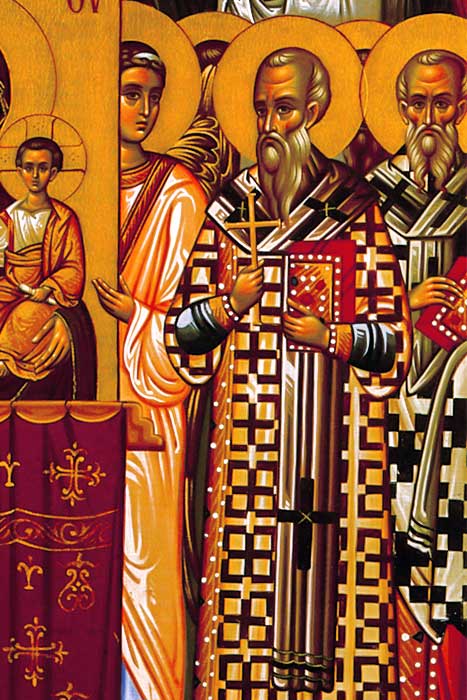
The icon of the Sunday of Orthodoxy commemorates the “restoration” of icons in the churches and to their use in Orthodox worship. The focal point of the icon is an icon itself, the Virgin Hodegetria, a popular depiction of the Theotokos as “Directress,” or literally “She who shows the way to God.” The icon is carried by two angels.
To the left of the icon is the Empress Theodora and her son Michael III. To the right of the icon are the Patriarchs Methodios and Tarasios. The icon is surrounded by numerous saints who struggled against the Iconoclastic heresy.
The icon also represents the triumphant procession that was made on Sunday, March 11, 843, from the Church of the Theotokos in Blachernai to Hagia Sophia, where a Liturgy was celebrated to mark the restoration of icons. |
| |
|
Glory to Jesus Christ!
This is the first week of the Great Fast. Please see the schedule below for services.
This Saturday (3/23), we will host the Sunday of Orthodox Vespers at 4:00 PM. Please plan on attending and bring an icon for the procession!
We still need help with preparations for our guest so please speak with Deb or Mtka Mary about how you can help.
Finally, I'll be out of town March 29-April 1 leading a retreat for the OCF and the parishioners of St. Nicholas Ukrainian Orthodox Church, Greenwood, VA. In case of emergency, please contact Fr Christopher.
In Christ,
Fr Gregory |
| |
This Week at Ss Cyril & Methodius
Monday, March 18
- 9:45-11:00 AM: OCF Day of Prayer
- 2:00 PM- 5:30 PM: Office Hours/Confessions
- 6:00 PM: Canon of St Andrew
Tuesday, March 19
- 4:30 PM- 5:45 PM: Confessions
- 6:00 PM: Canon of St Andrew
Wednesday, March 20
- 5:00 PM- 5:40 PM: Confessions
- 6:00 PM: Presanctified Liturgy
Thursday, March 21
- 2:00 PM- 5:00 PM: Office Hours/Confessions
- 5:30 PM: Canon of St Andrew & OCF Meeting
Saturday, March 23
- 3:00 PM: Catechumen Class (canceled)
- 4:00 PM: Pan-Orthodox Vespers and Reception
Sunday, March 24: Sunday of Orthodoxy
- 9:00 AM: Hours & Precommunion Prayers
- 9:30 AM: Divine Liturgy
- 4:00 PM: Great Vespers (Annunciation)
|
| |
Looking Ahead
Monday, March 25 (Feast of the Annuniciation)
- 7:000 AM: Divine Liturgy
- 2:00 PM- 5:30 PM: Office Hours/Confessions
- 6:00 PM: Canon of St Andrew
Wednesday, March 27
- 2:00 PM- 5:30 PM: Office Hours/Confessions
- 6:00 PM: Presanctified Liturgy
Thursday, March 28
- 2:00 PM- 5:00 PM: Office Hours/Confessions [canceled]
Friday, March 29-April 1: Fr Gregory of town
Saturday, March 30
- 3:00 PM: Catechumen Class [canceled]
- 4:00 PM: Choir Rehearsal
- 5:00 PM: Great Vespers
- 6:00 PM: Confessions
Sunday, March 31: Sunday of St Gregory Palamas
- 9:00 AM: Hours & Precommunion Prayers
- 9:30 AM: Divine Liturgy
- 4:00 PM: Pan-Orthodox Vespers and Reception (Assumption)
|
| |
Hymns After the Small Entrance
Tone 1 Troparion (Resurrection)
When the stone had been sealed by the Jews, while the soldiers were guarding Thy most pure body, Thou didst rise on the third day, O Savior, granting life to the world. The powers of heaven therefore cried to Thee, O Giver of Life: “Glory to Thy Resurrection, O Christ! Glory to Thy Kingdom!//Glory to Thy dispensation, O Thou Who lovest mankind!”
Tone 2 Troparion (Sunday of Orthodoxy)
We venerate Thy most pure image, O Good One; and ask forgiveness of our transgressions, O Christ our God. Of Thine own will Thou wast pleased to ascend the Cross in the flesh and deliver Thy creatures from bondage to the Enemy. Therefore with thankfulness we cry aloud to Thee: “Thou hast filled all with joy, O our Savior,//by coming to save the world.”
Tone 4 Troparion (Forefeast)
Today is the prelude of joy for the universe! Let us anticipate the feast and celebrate with exultation: Gabriel is on his way to announce the glad tidings to the Virgin; he is ready to cry out in fear and wonder://“Rejoice, O Full of Grace, the Lord is with thee!”
Glory to the Father, and to the Son, and to the Holy Spirit,
Tone 8 Kontakion (Sunday of Orthodoxy)
No one could describe the Word of the Father; but when He took flesh from thee, O Theotokos, He accepted to be described, and restored the fallen image to its former state by uniting it to divine beauty.//We confess and proclaim our salvation in words and images.
now and ever, and unto ages of ages. Amen.
Tone 8 Kontakion (Forefeast)
Thou art the beginning of salvation for all of us on earth, Virgin Mother of God. For the great Archangel Gabriel, God’s minister, was sent from heaven to stand before thee to bring thee joy://Therefore, we all cry to thee: “Rejoice, O unwedded Bride!” |
| |
|
Epistle: Hebrews 11:24-26; 32-12:2
Brethren, by faith Moses, when he was grown up, refused to be called the son of Pharaoh's daughter, choosing rather to share ill-treatment with the people of God than to enjoy the fleeting pleasures of sin. He considered abuse suffered for the Christ greater wealth than the treasures of Egypt, for he looked to the reward.
And what more shall I say? For time would fail me to tell of Gideon, Barak, Samson, Jephthah, of David and Samuel and the prophets -- who through faith conquered kingdoms, enforced justice, received promises, stopped the mouths of lions, quenched raging fire, escaped the edge of the sword, won strength out of weakness, became mighty in war, put foreign enemies to flight. Women received their dead by resurrection. Some were tortured, refusing to accept release, that they might rise again to a better life. Others suffered mocking and scourging, and even chains and imprisonment. They were stoned, they were sawn in two, they were killed with the sword; they went about in skins of sheep and goats, destitute, afflicted, ill-treated -- of whom the world was not worthy -- wandering over deserts and mountains, and in dens and caves of the earth.
And all these, though well attested by their faith, did not receive what was promised, since God had foreseen something better for us, that apart from us they should not be made perfect.
Gospel: John 1:43-51
The following day Jesus wanted to go to Galilee, and He found Philip and said to him, “Follow Me.” Now Philip was from Bethsaida, the city of Andrew and Peter. Philip found Nathanael and said to him, “We have found Him of whom Moses in the law, and also the prophets, wrote—Jesus of Nazareth, the son of Joseph.”
And Nathanael said to him, “Can anything good come out of Nazareth?”
Philip said to him, “Come and see.”
Jesus saw Nathanael coming toward Him, and said of him, “Behold, an Israelite indeed, in whom is no deceit!”
Nathanael said to Him, “How do You know me?”
Jesus answered and said to him, “Before Philip called you, when you were under the fig tree, I saw you.”
Nathanael answered and said to Him, “Rabbi, You are the Son of God! You are the King of Israel!”
Jesus answered and said to him, “Because I said to you, ‘I saw you under the fig tree,’ do you believe? You will see greater things than these.” And He said to him, “Most assuredly, I say to you, hereafter you shall see heaven open, and the angels of God ascending and descending upon the Son of Man.”
++++++++++++++++++++++
Hymn to the Theotokos
All of creation rejoices in thee, O Full of Grace:
the assembly of angels and the race of men.
O sanctified temple and spiritual paradise,
the glory of virgins,
from whom God was incarnate and became a Child:
our God before the ages.
He made thy body into a throne,
and thy womb He made more spacious than the heavens.
All of creation rejoices in thee, O Full of Grace.//
Glory to thee!
Communion Hymn
Praise the Lord from the heavens, praise Him in the highest!
Rejoice in the Lord, O you righteous; praise befits the just!
Alleluia, Alleluia, Alleluia! |
| |
|
By the age of 25, about 60% of those baptized as infants will no longer consider themselves members of the Orthodox Church. A parish on a university campus is an important witness not only to the surrounding community but also to high school age and younger parishioner. Establishing a parish on the campus of the University of Wisconsin-Madison helps remind young people that graduating high school doesn't mean "graduating" from the Church. Please consider joining those who have committed their time, treasure and talent in establishing an Orthodox community on the Isthmus.
Please help us reach your children and grandchildren with the Gospel of Jesus Christ by clicking the gofundme link. |
| |
|