|
1020 Regent St
(Lower Level)
Madison, WI 53715
|
| |
|
Click above to send names of those to be commemorated at Liturgy. |
| |
Sunday, January 28, 2024
Tone 1
34th Sunday after Pentecost; Ven. Ephraim the Syrian |
| |
Venerable Ephraim the Syrian
Commemorated on January 28
(OCA) Saint Ephraim the Syrian, a teacher of repentance, was born at the beginning of the fourth century in the city of Nisibis (Mesopotamia) into the family of impoverished toilers of the soil. His parents raised their son in piety, but from his childhood he was known for his quick temper and impetuous character. He often had fights, acted thoughtlessly, and even doubted God’s Providence. He finally recovered his senses by the grace of God, and embarked on the path of repentance and salvation.
Once, he was unjustly accused of stealing a sheep and was thrown into prison. He heard a voice in a dream calling him to repent and correct his life. After this, he was acquitted of the charges and set free.
The young man ran off to the mountains to join the hermits. This form of Christian asceticism had been introduced by a disciple of Saint Anthony the Great, the Egyptian desert dweller Eugenius.
Saint James of Nisibis (January 13) was a noted ascetic, a preacher of Christianity and denouncer of the Arians. Saint Ephraim became one of his disciples. Under the direction of the holy hierarch, Saint Ephraim attained Christian meekness, humility, submission to God’s will, and the strength to undergo various temptations without complaint.
Saint James transformed the wayward youth into a humble and conrite monk. Realizing the great worth of his disciple, he made use of his talents. He trusted him to preach sermons, to instruct children in school, and he took Ephraim with him to the First Ecumenical Council at Nicea (in the year 325). Saint Ephraim was in obedience to Saint James for fourteen years, until the bishop’s death in 338.
After the capture of Nisibis by the Persians in 363, Saint Ephraim went to a monastery near the city of Edessa. Here he saw many great ascetics, passing their lives in prayer and psalmody. Their caves were solitary shelters, and they fed themselves with a certain plant.
He became especially close to the ascetic Julian (October 18), who was of one mind with him. Saint Ephraim combined asceticism with a ceaseless study of the Word of God, taking from it both solace and wisdom for his soul. The Lord gave him a gift of teaching, and people began to come to him, wanting to hear his counsel, which produced compunction in the soul, since he began with self-accusation. Both verbally and in writing, Saint Ephraim instructed everyone in repentance, faith and piety, and he denounced the Arian heresy, which at that time was causing great turmoil. Pagans who heard the preaching of the saint were converted to Christianity.
He also wrote the first Syriac commentary on the Pentateuch (i.e. “Five Books”) of Moses. He wrote many prayers and hymns, thereby enriching the Church’s liturgical services. Famous prayers of Saint Ephraim are to the Most Holy Trinity, to the Son of God, and to the Most Holy Theotokos. He composed hymns for the Twelve Great Feasts of the Lord (the Nativity of Christ, the Baptism, the Resurrection), and funeral hymns. Saint Ephraim’s Prayer of Repentance, “O Lord and Master of my life...”, is recited during Great Lent, and it summons Christians to spiritual renewal.
From ancient times the Church has valued the works of Saint Ephraim. His works were read publicly in certain churches after the Holy Scripture, as Saint Jerome tells us. At present, the Church Typikon prescribes certain of his instructions to be read on the days of Lent. Among the prophets, Saint David is the preeminent psalmodist; among the Fathers of the Church, Saint Ephraim the Syrian is the preeminent man of prayer. His spiritual experience made him a guide for monastics and a help to the pastors of Edessa. Saint Ephraim wrote in Syriac, but his works were very early translated into Greek and Armenian. Translations into Latin and Slavonic were made from the Greek text.
In many of Saint Ephraim’s works we catch glimpses of the life of the Syrian ascetics, which was centered on prayer and working in various obediences for the common good of the brethren. The outlook of all the Syrian ascetics was the same. The monks believed that the goal of their efforts was communion with God and the acquisition of divine grace. For them, the present life was a time of tears, fasting and toil.
“If the Son of God is within you, then His Kingdom is also within you. Thus, the Kingdom of God is within you, a sinner. Enter into yourself, search diligently and without toil you shall find it. Outside of you is death, and the door to it is sin. Enter into yourself, dwell within your heart, for God is there.” |
| |
|
Glory to Jesus Christ!
Congratulations to Gregg and Jenny on the birth of their daughter Iona Marilyn Sanford was born at 1:57, January 19, 2024 (21” long. 7 lb 2 oz).
If you would like your home or business blessed, please contact either Fr Gregory or Fr Christopher and schedule an appointment.
This month is the anniversary of the repose of Fr Patrick Kinder and Fr Michael Vanderhoef. We will serve a memorial for both men this Sunday immediately after the Divine Liturgy.
In Christ,
Fr Gregory |
| |
This Week at Ss Cyril & Methodius
Wednesday, January 24
- 1:00-5:00 PM: Office Hours/Confessions
Thursday, January 25
- 1:00-5:00 PM: Office Hours/Confessions [canceled]
Saturday, January 27
- 3:30 PM: Catechumen Class
- 4:30 PM: Confessions
- 5:00 PM: Great Vespers
- 6:00 PM: Confessions
Sunday, January 28
- 9:00 AM: Hours & Precommunion Prayers
- 9:30 AM: Divine Liturgy
- 10:30 AM: Memorial Service for Fr Patrick and Fr Michael
|
| |
Looking Ahead
Wednesday, January 31
- 1:00-5:00 PM: Office Hours/Confessions
Thursday, February 1
- 1:00-5:00 PM: Office Hours/Confessions
- 5:30 PM: Vespers (Feast of the Presentation)
Friday, February 2
- 7:00 AM: Divine Liturgy (Feast of the Presentation)
Saturday, February 3
- 3:30 PM: Catechumen Class
- 4:30 PM: Confessions
- 5:00 PM: Great Vespers
- 6:00 PM: Confessions
Sunday, February 4
- 9:00 AM: Hours & Precommunion Prayers
- 9:30 AM: Divine Liturgy
|
| |
Hymns After the Small Entrance
Tone 1 Troparion (Resurrection)
When the stone had been sealed by the Jews, while the soldiers were guarding Thy most pure body, Thou didst rise on the third day, O Savior, granting life to the world. The powers of heaven therefore cried to Thee, O Giver of Life: “Glory to Thy Resurrection, O Christ! Glory to Thy Kingdom!//Glory to Thy dispensation, O Thou Who lovest mankind!”
Tone 4 Troparion (Ss Cyril and Methodius)
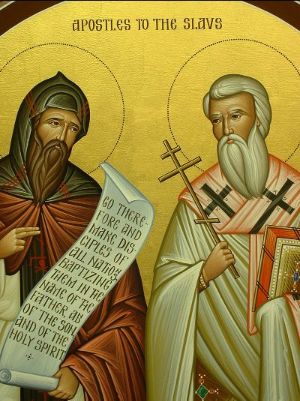
Divinely-wise Cyril and Methodius, / equals-to-the-apostles and teachers of the Slavs, / entreat the Master of all / to strengthen all nations in Orthodoxy and unity of mind, / to grant peace to the world and to save our souls.
Tone 8 Troparion (Ven. Ephraim)
By a flood of tears thou didst make the desert fertile, and thy longing for God brought forth fruits in abundance. By the radiance of miracles thou didst illumine the whole universe.//Our holy Father Ephraim, pray to Christ our God to save our souls!
Tone 1 Kontakion (Resurrection)
As God, Thou didst rise from the tomb in glory, raising the world with Thyself. Human nature praises Thee as God, for death has vanished. Adam exults, O Master! Eve rejoices, for she is freed from bondage and cries to Thee://“Thou art the Giver of Resurrection to all, O Christ!”
Tone 3 Kontakion (Ss Cyril and Methodius)
Let us honor the sacred pair, who translated divine scripture / pouring forth a fountain of divine knowledge from which we still draw today. / Now as you stand before the throne of the Most-high / we call you blessed, Cyril and Methodius, / as you fervently pray for our souls.
Glory to the Father, and to the Son, and to the Holy Spirit.
Tone 2 Kontakion (Ven. Ephraim)
Ever anticipating the hour of Judgment, thou didst lament bitterly, venerable Ephraim. Through thy deeds thou wast a teacher by example;//Therefore, universal Father, thou dost rouse the slothful to repentance.
now and ever, and unto ages of ages. Amen.
Theotokion Tone 6
O protection of Christians that cannot be put to shame, / O mediation unto the Creator unfailing, / disdain not the suppliant voices of sinners, / but be thou quick, O good one, to help us who in faith cry unto thee; / hasten to intercession and speed thou to make supplication, // thou who dost ever protect, O Theotokos, them that honour thee. |
| |
|
Epistle: Colossians 3:4-11
Brethren, when Christ who is our life appears, then you also will appear with Him in glory. Therefore put to death your members which are on the earth: fornication, uncleanness, passion, evil desire, and covetousness, which is idolatry. Because of these things the wrath of God is coming upon the sons of disobedience, in which you yourselves once walked when you lived in them. But now you yourselves are to put off all these: anger, wrath, malice, blasphemy, filthy language out of your mouth. Do not lie to one another, since you have put off the old man with his deeds, and have put on the new man who is renewed in knowledge according to the image of Him who created him, where there is neither Greek nor Jew, circumcised nor uncircumcised, barbarian, Scythian, slave nor free, but Christ is all and in all.
Gospel: Matthew 22:35-46
Then one of them, a lawyer, asked Him a question, testing Him, and saying, “Teacher, which is the great commandment in the law?”
Jesus said to him, “‘You shall love the Lord your God with all your heart, with all your soul, and with all your mind.’ This is the first and greatest commandment. And the second is like it: ‘You shall love your neighbor as yourself.’ On these two commandments hang all the Law and the Prophets.”
While the Pharisees were gathered together, Jesus asked them, saying, “What do you think about the Christ? Whose Son is He?”
They said to Him, “The Son of David.”
He said to them, “How then does David in the Spirit call Him ‘Lord,’ saying:
‘The Lord said to my Lord,
“Sit at My right hand,
Till I make Your enemies Your footstool” ’?
If David then calls Him ‘Lord,’ how is He his Son?” And no one was able to answer Him a word, nor from that day on did anyone dare question Him anymore. |
| |
|
By the age of 25, about 60% of those baptized as infants will no longer consider themselves members of the Orthodox Church. A parish on a university campus is an important witness not only to the surrounding community but also to high school age and younger parishioner. Establishing a parish on the campus of the University of Wisconsin-Madison helps remind young people that graduating high school doesn't mean "graduating" from the Church. Please consider joining those who have committed their time, treasure and talent in establishing an Orthodox community on the Isthmus.
Please help us reach your children and grandchildren with the Gospel of Jesus Christ by clicking the gofundme link. |
| |
|